
Learning To Swim With Leviathan
This text is dedicated to Dave Tobey and the crew of The Spill, as well as all of the people who keep that spirit alive to this day.
Thoughts on music and survival.
A text by garbageface, with exceptions.
First printed by Vide Press, Toronto, 2019 — RAP WILL EAT ITSELF, catalogue number RWEI_014.
Leviathan
raise yr head above the waves and meet us
for it is the time of reckoning
the waters below us chop and roil
while we toil and twist
Leviathan
bless us as we dive
searching for our salt
remembering the words you taught us
Leviathan
guide us in destroying what does not nourish us
and devouring what does
until we turn inside out
in becoming
Leviathan
the time of reckoning is always and forever

I. the map
A map is not the territory it represents, but, if correct, it has a similar structure to the territory, which accounts for its usefulness.
— Alfred Korzybski, Science and Sanity
Imagine you’re on a big boat with all of the musicians and artists you’ve ever known, and you’re adrift in a vast, choppy sea.
Before you boarded, you were each given a map. In fact, each of you holds one in your hands. Have a look.
You started your journey on a dock. Above the dock hung a crumbling wooden sign painted with the word “inspiration.” It’s been so long since you left the dock; you think the words were painted blue, but you’re not totally sure anymore.
Starting at the bottom of the map, a dotted line emerges from the X marking the dock. The dotted line juts forward with purpose. The first stop on the map is “practice.” You barely remember stopping there, so long ago.
After practice, many dots, moving upward: Your first show. More practice. Local notoriety. More practice. A chance to open for a hero of yours. More practice. Your first tour, and then your second. The dotted line splits in various directions and those different directions have different end points.
“How long have we been adrift?”
The voice comes from over your shoulder as you try to follow one of the dotted lines, and compare it to the water around you. The sun gets in your eyes. You don’t reply. The ink on the map has been smudging for some time now. You ask a friend to compare maps. They don’t look right together, but they share a commonality. You seem to have an older map. When you look at your friend’s map, it has different mile-markers: “YouTube virality”; “Dominate Social”; “Give It Away For Free”; “Streaming Stats”; “Get Likes.”
Near the top of each map, in a distressed font, partly scratched out, the words are almost illegible: “THE DEAL.”
All of a sudden, one of the people on the boat grabs a set of brightly coloured balloons that are floating by, and they begin to float away with them. It looks like the rapture, you think to yourself. As they’re borne away by the bright balloons, a look of panic crosses over their face and they look back at you.
You make eye contact, and they say something to you, which is hard to hear over the wind: “I’ll be back for you.” You know it’s not true, but you nod anyway, and reply “Good luck.”
The person floats away and about 10 more appear to take their place on the deck.
“How long have we been adrift?”
Every map tells a story, but we need to be clear about something: The map is not the territory. Ideally, maps are supposed to describe their territory as accurately as possible. On this boat, adrift in this sea, the relationship between map and territory has become a blurry one indeed.
II. the territory
The territory no longer precedes the map, nor survives it.
— Jean Baudrillard, Simulacra and Simulation
How do you make a map of endless, choppy water?
As the giant boat makes its way through the waves, to say that the maps we hold do not match the territory is an understatement. Indeed, when you lift your eyes from your map, and look out at the territory around you, you may be shocked.
The waters roil and shift and you can feel that they’ve been churning for thousands of years. The most important aspect, though, is that it doesn’t look like any water that you’ve seen before. Instead, it looks cartoonishly evil. Weirdly, it looks like the childish and sharp waves that pepper the frayed map you’re holding. You’re starting to feel like the longer you hold the map, the more the territory takes after it.
Around you, you see signs attached to buoys. They look odd and reading them is difficult, like trying to tell the time in a dream.
The only remotely solid territory you have to stand on is the great vessel you boarded, along with everyone else. You look around and see that the vessel is made up of many planks and boards, pulleys and rope, canvas sails. As you stop to admire a particular section, oaken and sturdy, a voice comes from over your shoulder.
“CD money.”
“What?”
“CD money. That section was built with CD money. And that one over there,” the person gestures over to a group of people in suits actively working on the ship as it lumbers forward, “streaming money.” They gesture over to another group of people working hard to patch a leak. “Touring,” they say with a chuckle.
You realize the ship is continually being built and rebuilt as it floats, with different people building different parts using whatever resources they have at their disposal. Some parts of the ship are impressive indeed, while other parts look ready for the sea to swallow them.
III. rapture
In the Book of Revelations, after the Seventh Trumpet sounds and the Third Woe is unleashed, the story goes that dead believers and living believers alike will be raised up to heaven to be with God. The dead go first—it’s kind of a reward for having seen their belief through to their own end—followed by the living. It’s a permanent vacation of sorts: once you are raptured, you don’t come back.
The choice of who is raptured isn’t an accident. It’s more of an accounting exercise, where the spiritual record is combed through and those who are in good standing are brought up to take their rightful place at The Right Hand of God.
Different sects of Christianity have different views on when the rapture happens in the grand scheme of the Apocalypse. Depending on the doctrine you subscribe to, it either happens before, during, or at the tail end of a long period of tribulation.
To be raptured as a Christian in good standing is meant to be the ultimate finish line. It’s not necessarily the end of history, but it’s the closing of the book for rank and file Christians. In many ways, it’s the goal to strive for. It might be worth pointing out that the word rapture, as translated from Latin, has connotations of being captured, or taken away.
On the boat, it seems like the people grabbing the balloons and floating away are doing so by chaotic coincidence, but it’s no accident either; only those who truly believe in those balloons and their promise have a chance to see what’s up in the clouds. And just like the rapture for Christians, it’s not the closing of a book at all, it’s just the beginning of another chapter.

IV. lottery
When we see our friends float away holding the balloons, it’s supposed to make us feel hopeful too, but there’s a hint of nausea in it. It’s no rapture. It feels more like a capture, or a lottery. Whatever it is, it doesn’t feel like a cause for celebration.
The lottery is one of the best ways to give otherwise hopeless people—people who have never and will never see the future as a better place than their present—some shred of it. In general, the lottery works because we see people win. There have to be winners, because if we never saw one, why would we ever play?
And so, people play, a few win, and the rest keep playing. Have you ever heard of someone winning the lottery and still playing? The lottery is set up so that most of us just keep feeding the pot, but we never get fed.
So let’s look at what it means to actually win a lottery.
In a lottery, people who are more in need of money don’t get extra chances to play by virtue of their need. People whose lives could be greatly improved by winning don’t get better odds. It has nothing to do with merit. If you manage to beat the odds through sheer luck, you can choose a lump-sum payout. This is usually a much smaller proportion of the money you actually won—sometimes less than half—but you get it all at once. The other form of payout is periodical and meted out over a longer span of time, sometimes the rest of your life. You don’t get it all at once, but you’re guaranteed something for a while.
In music, “making it” is supposed to seem like a lottery, like a lucky person just picked the right numbers, got a hold of some balloons, and floated off into the sky. However, in this rapture lottery, the people who “win” often make a series of choices that position them for better odds. It’s not exactly the same as buying more tickets or choosing more numbers. When you want to “win” the music rapture lottery and grab hold of those balloons, you increase your odds by aligning yourself in different ways with various forces in The Industry that propel people upwards and into the rarefied atmosphere. This often involves activities that really and truly have nothing to do with music. More often than not, they are business decisions that are made based on the viewpoint that The Industry is a ladder to be climbed, and music is the thing that helps you climb it.
Sure, sometimes the people that win this rapture lottery really and truly deserve it, but that is an accident, a happenstance. In any lottery, the marriage of luck and merit is a glitch in the system, not a feature of it.
So the question you need to ask yourself before we go any further is: am I a musician because I want to win a lottery that’s not a lottery at all? Am I willing to buy that ticket and take that ride?
If not, why are you here? Why are we here? The chop is strong, and the wind seems never-ending. The water is deep and very dark. Occasionally, however, beams of sunlight poke through the clouds. Leviathan groans below.
V. how did we get here?
So. Why do we play music? Why were we so willing to cast off from the dock and begin this journey?
To answer this, try not to think of your position now, in the complicated body you currently inhabit. Try to think all the way back to when you started, when you had no experience under your belt. It may be a time before the record of your memory even begins, but do your best to go back as far as you can.
Why did you set off from shore in the first place? What made you want to express yourself through sounds, textures, and vibrations of air?
These are serious questions. Take some time to think about them. For all that you must deal with on the boat—the crowding, the seasickness, the confusion—think hard.
VI. we’re not going to make it
If you’re creating music in the hopes of winning a false lottery and grabbing hold of those balloons—whether your end goal is to attain fame, fortune, or something equally elusive—I wish you luck, but these words are not for you.
If you’re creating music as a practice of self-examination, sonic exploration, energy redistribution, community building, ritualism, growth, political dissent, ecstatic dance, emotional sublimation, experimentation, spiritual probing, or unabashed motherfucking rage or joy, then welcome. I have good news and bad news for you.
The bad news is that their map is irrelevant.
The good news is that you’re free. And where we’re going, we don’t need their maps.
The problem with music is that so much of it is commodified on an industrial scale, in a way that other art forms are not. This commodification creates a cascade of effects, some good, many bad, but all pernicious and persistent, that affect practitioners at all levels. We must resist this industrial commodification of our music, and ourselves, to stay artists at all.
Music is commodified industrially, and many of the people who create music are commodified almost as thoroughly (and in some cases, even more so). For better or for worse,[[1]] it’s an art form that can be captured, packaged, consumed, and distributed for minimal cost. That has made it vulnerable to forces that really don’t care what they’re selling. They just need to sell something, and music is a hell of a something.
This process of commodification has been so successful precisely because music is so fucking intoxicatingly entrancing. These spells, and the people who cast them, have a great power over us. They have changed our fucking lives with these spells, they’ve given us limitless energy. When one of these spells touches us, the well it opens up goes as deep we can possibly dig, past the soil, past the groundwater, deeper into the crust and down into the core. These spells teach us and warn us and propel us forward, and we’d do almost anything to feel those feelings. The Industry’s commodification of music works precisely because it means so much to us, and they know that.
If you’re a practitioner of music, and want to share your magick with other people, you’ll be faced with a great many choices about who you align yourself with, how you present your own identity, how you engage with social media, how your music fits into the zeitgeist, how you make a living, and so on. At every turn, the forces of The Industry will exert influence and gravity on you, and it will be challenging to maintain your core.
If you’re a practitioner of music, the energy and intention you bring to your music is your first priority. Intrinsically tied to that is the way in which you manifest that energy and intention out in the world. The way you sustain your practice is a close second. Everything else is a distraction.
There is a time and a place to think of all that. But for now, try to put it all in brackets, so we can take a dive and meet Leviathan.
Leviathan
you who breathe what we cannot
guide our vessel between these rocks
Leviathan
you great beast! we throw ourselves to you
teach us the sea
teach us to see through mists and fogs
and the ways of waves
though we know not when nor how
we can see fire in the distance
a respite or a mirage
if there was a beginning
there must be an end

before we float further
What is music? Have you ever asked yourself this question?
In the sections that follow, I’ll do my best to describe music in the most fundamental and essential ways possible. These are the ways that I see music in its most basic forms and functions.
Why do we need to define music if we’re already making it?
One of the most beautiful things about music is the way that it can help us communicate nonverbally. Musical magick can call forth such powerful feelings and moments that to even think of sullying them with words feels wrong. By trying to define this beautiful thing, I’m not trying to temper the joyous and ecstatically undefinable.
Instead, I’m going to spend some time looking at how music functions mechanically, and then how The Industry takes those mechanics and shapes them to serve economic ends. We won’t get too deep into the seaweed of how music works, nor how music is worked, yet. But we’ll set enough context together so that we can move on to the bigger topic at hand: how to survive at sea.
VII. music is an art form that exists in time
Music is what’s known as a temporal art form. In other words, it’s something that exists in time. A piece of music is not a sculpture, a formed thing that sits in the middle of a room, that you can walk around and see from various angles as a fixed object. A piece of music has a beginning, unfolds for a certain amount of time, and then is closed and done. To experience it, you must exist with it for that time period, too.
There are no shortcuts that we know of. There is no way to “hear” a piece of music all at once,. You can’t even really get the crib notes. You just have to sit with it.
Don’t get it twisted: music’s temporality has nothing to do with song lengths, whether long or short. It’s also not about the length of albums, though for the purposes of this discussion, albums are an interesting case study.
Music exists in time, and existence is about commitment. To commit to a piece (or collection of pieces) of music, whether as a performer or audience member or at-home listener, you need to be there for the duration, and give it your attention.
To really appreciate the temporality of music, it’s worth listening to a whole bunch of it, in a focused way, short compositions and long ones. The most important part is to sit with it. Turn off your phone as you would at a movie, close out the distractions, and listen to the entire length of a song, or an album, without doing anything else. Hear how it transitions from section to section, or song to song. Feel the peaks and valleys of it. Notice the textures, the beats, the way things change.
Ask yourself: How does your music exist in time? What kind of temporal experience are you trying to create?
VIII. music is an art form that exists in space
Though music is mainly temporal, it’s also spatial. Music is made by instruments and speakers physically moving and vibrating the air. Music is often made of recordings of instruments and people creating sounds in a physical space, and then those sounds are mixed and played back on speakers that exist in a different physical space. And of course, live music is created in a variety of physical spaces.
Physical space is one of the most important contexts that your music exists in. Whether you choose to ignore the physical context or not, it has an effect on everyone who experiences it.
Imagine a black metal band playing in a frozen forest. Now imagine that same band playing in a children’s playground. Now imagine them playing in a church. Now imagine them playing in a country music bar. Now, imagine listening to your favourite record on your favourite stereo system. Now imagine listening to it playing from the other end of a cave. Now imagine it being played on earbuds.
Now, imagine your favourite band playing in a sweaty, packed club. Now imagine them playing in an art gallery with 20 chairs in it and everyone is sitting. Now imagine them playing a show they thought would be packed, but isn’t.
Now forget all of these rather vulgar examples. The reality is much more particular and subtle. Every room you create music in has an effect—whether acoustic, emotional, or otherwise—on the music created in that space. So does every PA system or set of speakers. The audience is also part of the spatial context, and may even weigh the heaviest upon it.
Ask yourself: How does your music exist in space? What kind of spatial, physical experience are you trying to create?
IX. music is an art form that is intangible
According to most of our senses, music doesn’t exist. We can’t see it, smell it, or taste it. We can hear it, and to a different degree we can feel it physically. It’s intangible, yes, but it still takes up space.
Music is made through sound waves, which compress, decompress, and rarefy the air. Recording music often requires microphones, which have sensitive membranes that capture sound vibrations and then transform those vibrations into an electrical signal that can be captured to tape (or a computer hard drive). Speakers—from the biggest subs to the smallest earbuds—do the reverse: when they vibrate, they move the air and when that air hits our eardrums, it translates into sound and music. There’s a lot more to this, but that’s the basic loop to keep in mind.[[2]]
Of course, music can be captured onto different media for playback. It’s still intangible, but physical formats give us the ability to feel like we “have” the music in our possession. When these physical media are played back on different devices, the speakers attached to those devices play the air, and once again, the music is there. More magick.
Why does this matter? The intangibility of music makes it very different from other, physically-inclined art forms, like painting, sculpture, and so on. Other art forms that share intangibility—like theatre, and to a lesser extent, film—are treated very differently by their makers, and the audience consuming them.
Ask yourself: How does your music embrace or reject intangibility? What kind of intangible-ness are you trying to create, or destroy?

X. the disrespect of time
Since music is primarily a temporal art form, the main way that it is disrespected is through time.
Temporality is part of the reason that “popular music” compositions tend to hover around 2-4mins in length. At some point, record companies figured out that 2-4mins was an ideal length of time in which to capture the attention of our lizard brains. The vast majority of people can easily pay attention for that length of time, especially if a piece of music is packed with hooks. But what if it’s not?
It actually doesn’t matter. Again, the length of a composition or an album is not the main issue here. A 10min grindcore album may be harder to sit through than an hours-long symphony.[[3]]
The issue is that, when it comes to time, attention, and music, The Industry has forcibly shaped the general public’s opinion of what an acceptable length of time to pay attention to music is. By extension, they’ve also dictated the same thing to musicians themselves, using sales as the barometer.
Compositions that are too long, or too short, tend to be seen as not commercially viable. The Industry thrived on singles—individual songs pressed onto vinyl, often with a sweet B-side—until the 60s, when “The Album” became seen as the statement piece. For the marginal cost of a bit more studio time, and for virtually the same manufacturing costs, The Industry could sell album units for much more than singles. In the late 80s, the 44-minute time limit of LPs was expanded to 74 minutes of music that could fit on CDs, and albums got longer. In the post-CD era, where albums can conceivably be any length at all, streaming has fostered a return to single songs, and playlists.
The amount of music that can fit on a record or a CD is a practical consideration, and one that’s worth thinking about as it relates to any given project. However, the format should fit what you want to express, not the other way around.
A tougher nut to crack is how we consume music, and the related issue of our attention spans when it comes to musical works. For a good majority of people, listening to music happens most often as a background activity, a soundtrack to doing something else. We simply don’t give music the time of day; we don’t give it our full attention for the time it requires. It’s a phenomenon that plagues both live and recorded music.
If music were a painting, this would be the equivalent of placing the painting in a garage or a shed, somewhere that you’re actually focused on doing something else. And when you do look at it, imagine that you only look at the bottom half. Or maybe you look at the whole thing, but only for a split second.
Imagine that.
XI. the disrespect of space
Though music is an art form that exists in space, finding spaces that are primarily geared towards providing the best possible musical experience is an exception, not the norm. Why?
Most venues that host live music, from big arenas to small capacity venues, are multipurpose rooms. Yes, hidden among those two extremes are theatres that have been built specifically with acoustics, performance, and visibility in mind. Let’s be generous and say they make up 1% of the rooms out there.
As an independent musician, you will most likely find yourself playing small cap rooms, alternative spaces, art galleries, houses, and other sundry venues. Almost none of these venues will make their money from music.
Instead, small cap rooms tend to make their money from sales of alcohol, and sometimes food. A successful night to you may mean that the room was full for your set, or that people responded well to the music and the context you presented it in; for the venue, success means sales of the other goods they’re selling. It’s not hard to see why this is a fucked up relationship: it places artist and the venue in a dynamic where they have clearly different goals and intended outcomes. That dynamic could be friendly, but it could also be quite adversarial.
This phenomenon scales upward. Mid-sized venues all the way up to arenas make money from many sources, but the actual performance of the music is not really one of them. In fact, for many of these venues, it doesn’t matter whether they’re hosting a concert or a hockey game. They just need people to fill the room and buy the other stuff that they make money from.
Of course, this is not to say that music and other things can’t coexist, that small cap venue owners are bad people, or that venues shouldn’t make money, somehow.[[4]] All of this, however, has effects on the space where your music exists, and the cascade of these effects can be brutal. When artists and venues are at cross purposes over their goals and outcomes, it necessitates a string of compromises where it’s likely that no one will win, and the quality of everything sinks in the process.
When you set out to start performing music, you will find yourself in spaces that absolutely enhance the music and mood your trying to convey. You will also find yourself in spaces where, at best, your performance feels like an afterthought, and at worst, spaces that are actively hostile towards musical expression. It will feel like you might as well be on the 10th floor of a building in which no one bothered to build an elevator.
Imagine that.
XII. the disrespect of the intangible
Music is intangible, but it can and does get captured onto different media, each of which has its own advantages and disadvantages. Choosing a medium on which to capture and present your music is a complicated process that often involves both financial and artistic considerations.[[5]]
The disrespect of the intangible comes in waves.
First and foremost, the disrespect comes from inside the house. Bands, artists, and labels often take their beautifully intangible magick spells and capture them in utter garbage: badly dubbed tapes, shitty CD presses, badly cut vinyl, and so on. We’ve all seen them, and heard them. At best, they are inaccurate representation of the music in question. At worst, they actively disrespect the effort that went into making the music, and the magick of it. These packages also make it more likely that no one will want to give it a chance.
It’s worth noting here that there’s a difference between lo-fi as an aesthetic choice of sound and lo-fi by virtue of laziness. Likewise with DIY packaging: there is DIY packaging with thought and intention, and packaging that is done in a DIY way because the artist can’t be fucked to bother.
Secondly, the disrespect comes from without. Record companies have made a fortune from capturing artists’ magick and making hard copies of it. There’s nothing inherently wrong with this process, but looking at the commercial history of recorded music, we see that The Industry’s main concern is selling plastic, not music. Music just happens to make a small piece of plastic worth a lot of money.
In many ways, when the digital era dawned, it seemed like it would be the end of record companies altogether. Who needs to buy plastic when a digital file takes up virtually no space? The situation was promising, but didn’t pan out the way we had hoped.
The intangibility of music has reached its apex in this era we now inhabit. Record companies have seized on intangibility and weaponized it, helping to usher in an age when any physical manifestation of music is seen as novelty, a souvenir. They are working overtime to cast music as permanently ephemeral, like a fleeting thought or passing fancy. Now that it’s in its sharpest focus, the intangibility of music is almost comical: you have access to millions and millions of songs on a device that fits comfortably in your pocket. You can even hold digital files, “hard copies,” millions of them, on that same device. A fairly comprehensive history of recorded music exists in your pocket, and it doesn’t even make the device weigh more.
You don’t even need to imagine that. It’s happening right now.

XIII. the beast below, the beast above
Beware that, when fighting monsters, you yourself do not become a monster.
— Friedrich Nietzsche, Beyond Good And Evil
These things about music are things you already know, and they seem so hilariously abstract and un-applicable to your current predicament on the boat. You’re sure you’ve had these thoughts before, but with the rolling and roiling of the waves, it’s hard to remember when, and why it even matters. There was a time when these thoughts may have been worth thinking about, even enjoyable. But now. . .
You hear a groan below the boat, very fucking deep below the boat. The whole boat vibrates, and it’s a different vibration than the waves. It is certain and steady.
Leviathan.
There’s something grounding about that bass. It’s thousands, maybe millions of years old. Maybe that was the first sound: when the planet was nothing but water, as the sun beat upon the sea, and the vapour from the water rose up to become the air, Leviathan’s bass-filled moans were the first music. Today, you can still hear the primordial call of Leviathan, though sometimes the noise and chatter among the people makes it hard to hear clearly. It’s trying to remind you of something.
Did you ever think about what happened to the friends you saw, floating away up into the air? Being jostled by the rough water, it’s easy to imagine that everything worked out well for them, even though they’re long out of sight.
Imagine, up there above the dark grey clouds, a lineup. A long line of rapture-ees, true believers, standing with slowly deflating bright balloons, shoulders starting to slump. The lineup is long, and at the far end of it is a roller coaster shaped thing, with a huge, lit up sign arching over it.
THE BEAST, it says.
A small group of people get called into the entrance of the roller coaster, the mouth of the beast, which is actually just another lineup. An even smaller group get called forward, and sit down in their carts. “NEXT STOP, THE BELLY!”, a voice shouts as the train of carts lurches forward and begins clicking uphill. The mood of the people in the carts looks a bit apprehensive, but they seem . . . into it. This should be fun.
The roller coaster climbs up its celestial hill into more clouds, and as the carts disappear into them, the screaming of the riders drifts downward. Are they having a good time? Are they terrified? Listen as closely as you can, but you really can’t tell. It could be neither, or both.
The carts return, but they’re only half full. The people that are left in the carts are covered in goo. It can’t possibly have been fun, but then they get off the roller coaster, wipe themselves off a bit, and immediately get back into the long line.
Where did the others go? They must have gotten stuck in the belly somewhere.
Leviathan,
you who have taught us that
the price of existence is eternal warfare
and the joy of eternal warfare is existence
stop here
do not go to war, unless there is war in yr blood
but remember,
there are many ways to wage it

becoming the beast above
The preceding passages were meant to give you some idea of how music works as an art form, and some idea of how the essence of music is corrupted by other concerns and factors.
Imagine the last time you were really, really dirty, completely covered head to toe in dirt, filth, and grime. Think of that moment when you were at your dirtiest, and imagine the skies opened up to cleanse you. You watch the water dissolve the dirt and turn dark, spreading onto the ground at your feet. What a fucking feeling.
What if the water itself was full of mud? What if the cleansing waters came and all you smelled was iron? What if the clouds where the rains came from had been corrupted by the same mud you were trying to wash away?
We’re going to try to get even closer to that beast up above now. We need to really see what’s going on in the clouds, so we can make a plan for how we’re going to survive down below.[[6]]
The following discussion of some of the “economics of the business” will seem laughably out of reach for many, if not most of you. They are out of reach for me too, and I’m done reaching for balloons. The point of digging into the numbers here is to give you an example of what the low-to-mid level of “making it” looks like, and how making even the most modest musical living can be a near-death experience.
XIV. sign here / intro
Perhaps the most misunderstood aspect of being a working musician is the signing of a record deal. It’s a cultural cliché that has become a simulacra in and of itself, a map of a map of a map. We picture cigar-chomping, ponytail-adorned Industry Guys giving fat cheques to passionate artists whose life immediately changes for the better.
Forget that image altogether. Toss it in the fucking bin and make sure you hit “delete forever.”
Let’s look at what a standard deal at lower level might entail, and for the sake of underlining the devil’s bargain this is, let’s look at this from an “indie” perspective that gives artists an ostensibly fair, even generous shake.[[7]] We’ll use some hypothetical numbers that are pretty close to the real thing.
The first thing you need to do is change how you hear the word “record deal.” For all intents and purposes, just about every “record deal” is actually a “record loan.” When you hear about a band getting a million dollar deal, think instead, “that band just took a bet that they can make a million dollars in royalty splits for the company.” Every penny that a band “gets” in a record deal needs to be paid the fuck back. In deal language, it’s called an “advance,” but remember, this is another word for loan, and the band is betting they can pay it back. They are literally gambling, on top of already winning the lottery.
So.
Imagine a band, let’s call them The Helvetica Scenario. They’ve got some traction on social media, had a couple of playlist placements, and they’ve been touring a bit. They have “momentum.” They’ve attracted the attention of Fun While It Lasted Records, who offer them a very nice deal for $75,000, to deliver an album and promote it with touring. The band is bound for one year from the release of the album to help sell the thing with the label.
First, they decide to save some money on a producer by writing and arranging their own material in their jam space. They considered what a good producer might bring to the table but they decided they couldn’t afford the flat rate plus 2% of gross sales the producer wanted from them and their label. They enter a pro level studio, and with their tight arrangements and a clear vision, they spend two weeks and only $20,000 to record, mix, and master the record, and to have an artist they know do the artwork.[[8]] They’ve used 1/5th of their advance.
The label has some in-house connections to a reasonably priced pressing plant, who makes 2,500 copies of their LP, with a couple of cool colour options, download codes, and a nice gatefold sleeve. They are super excited about having their first vinyl out, so they save some money on shipping by picking up the records themselves and taking a tour of the pressing plant. The records cost them a cool $12,000.
To get the album into the right hands, the label offers some in-house PR, but suggests the band spring for a concentrated PR push around the album release and tour. This comes to about $3,000, and now they’ve used up 35% of their advance.
From there, they decide they’re gonna need some sweet new merch for their sweet new album and sweet album release tour. They plan to play a month’s worth of shows from Vancouver to Halifax. They’ll be hitting 30 dates, and they imagine they’re gonna sell LOTS of shirts. They decide to make some hoodies too. For 120 shirts and 50 hoodies, they pay $2,400.
Before embarking on the tour, the band decides to replace their van that broke down twice on the last tour. They find a standard issue Ford Econoline with decent kilometers, that’s been well-maintained, and they pay a cool $12,000 for it. They also get some solid road cases ($4,000) for their gear, and some extra lighting and gear ($2,500) to bump up the quality of their tour production. They feel pretty much ready to go, and they’ve spent $55,900 of their $75,000 advance (loan).
With $19,100 remaining, they decide to set aside $4,100 for any tour emergencies that may come up—maybe some unexpected repairs to the van or replacing stolen gear if needed. They divide up the last $15,000, with each member in the 4-piece getting an equal $3,750 because the band are anarchists and want to be fair. This money basically pays the Toronto rent and various bills for each member of the band, for the time they spent in the studio and the month they’ll be away on tour.
So far so good, right?
XV. thugonomics / verse
The Helvetica Scenario is on top of the world. They’re slowly clicking up the first hill of that great roller coaster in the clouds.
Sure, they used up their whole advance before even hitting the road, but each member got paid a bit for their efforts, and they’re about to put out the best album of their lives. They’ve saved money by booking themselves their own tour of 200 cap rooms with the contacts they built over the years, and they’re managing their own affairs.[[9]] They feel like they’re sitting in a really good spot.
Helvetica’s deal with Fun While It Lasted had a very generous royalty rate: The band gets 25% of gross retail sales of the album (vinyl and digital) until the advance is paid back, and after that, the band gets 35%. Now remember: the album only cost $12,000 to press, but including the recording and PR, that total comes to $35,000. They got 2,500 copies made, and the label reckons with the really nice artwork and packaging, they can charge $30 for vinyl, $10 for digital, and of course they’ll make some money from streaming too.
Pre-sales of the album before the tour are solid by any measure. There are 500 pre-orders of the record, 500 pre-orders of the digital, and they can see a few hundred people have “pre-saved” the album to their streaming libraries (which doesn’t bring in any revenue, but feels nice to see anyway). The pre-sale gross of the vinyl is $15,000, and $5,000 for digital. Of that $20k, the band’s royalty is $5,000, which gets applied against their advance, so at this point they’ve paid back 6.66%, and they’ve only sold 1/5th of their records! This still seems promising, somehow.
On the tour,[[10]] across 30 shows, they do very well on album sales. The strength of their live shows has them selling about 20 copies (or more!) a night,[[11]] and many people who see them go home and stream. Some even buy the digital album. After the tour, they’ve sold another 650 copies of the vinyl ($19,500 gross), and 500 digital copies ($5,000 gross). Their royalty rate from these totals brings in another $6,125 which gets applied towards their advance.
After pre-sales and tour sales, they’ve paid back $11,125 of their $75,000 advance, or about 15%. There are 1,350 records left in the label’s hands, and the band has $63,875 left to pay back.
XVI. the long walk / chorus
The Helvetica Scenario has, by most measures of a lower-level signed band, done fantastically well with their album release. They’ve sold about a thousand digital copies, and 1,150 hard copies, which is awesome.
Let’s break down their road numbers, post-tour.
THS built their reputation on being a hard-working touring band—it’s part of the reason Fun While It Lasted was interested in them in the first place. So, booking their own cross-country tour was something they were able to do with existing contacts. It’s a good thing, because it saved them 15% of their take from every show, which would have gone to a booking agent.
They play 30 shows across Canada. Every show is in a 200-capacity room. 10 shows sell out, 15 shows have about 150 people show up, and the remaining handful of shows are kinda bombs (less than half capacity). Tickets for all of the shows are $15. The gross for the sellout shows is $3,000 each. The gross for the good shows is $2,250 each. The gross for the bombs is about $1,125 total. All in all, the gross income for the tour from tickets is $69,375. In each city, they worked with professional promoters and / or event management companies who took 15% per show, which is the first deduction off the top, and it hurts: $10,406.25. Good thing they saved that 10-15% by being their own booking agents.
Their second deduction off the top is paying the local bands. For each show they have one direct support act, and a lesser known opener. They give every direct support band $300, and every opener $150. All told, that’s another $13,500.
Using the most direct coast-to-coast routing, they travel about 6,500km from one end of Canada to another. In their tuned-up Econoline, which gets about 100km for every 16L of gas, this means they consume about 1,040L over the course of the tour. At an average of $1.20 per litre, they spend $1,248 in gas. They pay $140 on a couple of oil changes, and spend $200 on some miscellaneous other vehicle-related costs. Total expenses in that category come to $1,588.
Over the course of the tour, they mostly stay in hotels. After plenty of years of roughing it, they decide this is their chance to “live the life” on the road. The four-person band gets a single room with two queen beds (they double up and sleep in pairs), and they spend about $175 per night for this luxury. There are three nights where they stay with close friends and party. All in all, lodging comes to $5,500 total, and it sure beats sleeping on floors.
It still seems like they’re in great shape.
As a band, they decide that each of the four members will get $50 per diems[[12]] for food or whatever else they need ($6,000 total). For every three days, they’re going to splurge on a meal out together, which adds $2,000 to their food budget.
We’ve already counted the bands record sales on tour in the previous section. Let’s be generous and say they have sold all of their shirts (at $20 each) and all of their hoodies (at $50). The gross for all of that is $4,900. Fortunately, none of the venues they booked took a cut of their merch sales, a practice that’s becoming increasingly common at their level, and can be a commission of anywhere from 15-80%.
So far, their deductions come out to $38,994.25. When you add the merch sales to their tour income, they’re sitting with $35,280.75 profit from the tour. That seems alright doesn’t it?
Sure it does. And it is. Each member could take home about $8,820 before taxes (or $7,674 after taxes). Not too bad for a month on the road.
There was nothing in The Helvetica Scenario’s contract about the label taking tour money—they were lucky, because some of their peers are bound to provide merch sale money as payment against their advance—but they do still have $63,875 to pay back. Considering they already paid some living expenses from the advance, they decide to leverage all of their tour take against it. With a pretty successful tour under their belt and an album that is selling very well by any current measure, they’ve managed to pay back a good chunk of their advance.
After all that, however, they still owe the label $28,594.75.
XVII. chopping up pennies / coda
I was getting half a cent a record. Who ever heard of cutting a penny in half?
— Little Richard
Now for the punchline.
Being as well known as they are, The Helvetica Scenario’s label debut is highly anticipated, at least by their fans. They even get playlisted on a smaller rock playlist, which pushes their “single” over 1,000,000 streams. All in all, from their album launch to 2 months after their tour ends (one “quarter,” in the business world), they get just over 3,000,000 song streams. Not fucking bad, bud.
The average payout for a single stream is about $0.0084.[[13]] Their gross streaming revenue from this is $25,200, and their royalty from that is $6,300.
Leveraged against their advance, they still owe the label $22,294.75. We’re going to set aside the fact that streaming payouts aren’t immediate, and they may not see this money for 6 months or more.
And so, that’s the story of The Helvetica Scenario’s indie label debut. The band is 3 months into their 1-year contract, and they still owe the label over $20k. They grabbed the balloons and took the ride into the clouds. They excitedly got on the roller coaster to take a ride into the belly of the beast. Now, emerging from the belly, relatively intact but covered in goo, they’re going to decide whether they want to get back in line for another ride.
How is this possible? Am I being unfair?
Unfortunately not. These are generous estimates at every turn. The band have saved money by touring as a bare-bones unit, they’ve made some shrewd moves, and they’ve got a great royalty rate. Maybe they’ll manage to go on tour again without losing their day jobs, make the full advance back, and stay in the good graces of their label for an extension of their deal. Maybe they’ll even have the energy to write and produce another album by the start of next year, to keep the whole machine running. Maybe their label is one of the good ones, and helps them to devise strategies and plans to keep their machine running, in a way that feels like they’re staying true to their vision. Then again, maybe their label won’t.
But what if you don’t sign with a label? What if you keep it real and keep it independent as fuck all the way through? Could the totals look better?
Taking a deal comes with certain perks, but you end up chopping nearly everything you make into fractions. On the other hand, if a band owns their recordings and doesn’t chop up their revenue through royalties, they keep that money, and if they have this kind of Helvetica momentum, the numbers can look pretty good. If the band keeps things simple when it comes to recording, or does it themselves, they may be able to scrimp and save in creative ways. There are many ways to make the grind a bit less grindy, and even come out on top. The sliders on this make-a-living simulator are adjustable, and you can get some results that look better, for sure. It’s not a zero sum game, but often-times, when you adjust the sliders, some things go up at the expense of others.
The Deal
Advance (Loan): $75,000
Recording Expenses
Recording: $20,000
Vinyl Pressing (2500 copies): $12,000
Album Release PR: $3,000
Tour Investment
Merchandise: $2,400
Used Van: $12,000
Road Cases: $4,000
Stage Production: $2,500
Emergency Fund: $4,100
Personal Expenses
Band Salaries: $3,750 x 4
Total: $75,000
The Record
Pre-Orders
Digital – 500 Units: $5,000
Vinyl – 500 Units: $15,000
Tour Sales
Digital – 500 Units: $5,000
Vinyl – 650 Units: $19,500
Streaming
Total Streams: 3,000,000
Gross Streaming Revenue: $25,200
Royalty Rate: 25%
Total Royalties: $17,425
Total Remaining Owed: $57,575
The Tour
Total shows: 30
Room Capacity: 200
Sellout Shows: 10
Near-Full Shows: 15
Bomb Shows: 5
KM Traveled: 6,500
Gas Used: 1,040L
Ticket Revenue
All Shows: $69,375
Merch Revenue
Shirts & Hoodies: $4,900
Tour Expenses
Promoters (15%): $10,406.25
Direct Support / Openers: $13,500
Gasoline: $1,248
Oil Changes: $140
Hotels: $5,500
Misc: $200
Food & Per Diems: $8,000
Total Tour Revenue: $74,275
Total Tour Expenses: $38,994.25
Tour Net: $35,280.75
Remaining Advance To Be Repaid
$22,294.25
Leviathan
everything that is and ever was
is made of the sea
is wrought and wrung from the sea
among branches
among dead leaves
among those who make bread
among the press pages
the sweet smell of saccharine
meant to heal, meant to heal
best cases laid to waste
count the seconds left on the clock
you cannot make up time
nor catch up to it
the boatman abides no favours

becoming the beast below
Humans can hardly survive anywhere. It is both terrifying and comical, how vulnerable we are. We live comfortably, sort of, under exactly one condition: in the temperate patches of a very thin crust on a relatively small planet in a tiny corner of the known universe. Transport us anywhere else, and we will basically instantly die. Other planets will choke us; black holes will crush us. Even our own modest planet’s oceans will drown us, and its poles will freeze us, and its deserts will dry us into leathery husks. And yet: We still want to go everywhere.
— Sam Anderson
The story of The Helvetica Scenario isn’t meant to pound you into quitting doing the thing you love. The point was to provide a reality check, to allow you a chance to adjust your perceptions, and more importantly, to realign your intentions.
The truth is, the reality of The Industry is grim. In some ways, it’s similar to the landscape for other art forms. It’s possible to “make a living” doing this, but it is very, very hard, and exceedingly rare. The added dimensions of ego and fame make it a more alluring (and at once thorny) endeavor. Can you make money with music? Definitely. Can you get famous making music if you get lucky? Yes. Is “The Music Business,” in most of its incarnations, interested in our survival? Nah.[[14]] Does that mean we should stop doing this? Fuck no.
So where do we go from here?
First, let us disabuse ourselves of shiny promises that lead us only to vapour and adrenaline rides. We’re not here to gamble with our winnings within a false lottery. If your primary goal is being a face that people recognize and want to get close to, keep grabbing for balloons. Otherwise, it’s wasted energy in pursuit of the clouds.
Second, let us find our centre. What I mean by that is, let’s take some time and think about why we make music at all. Think about what motivates you to compose pieces, songs, lyrics, instrumentals. Again, that is the most important thing. And while you’re at it, try to go all the way back as far as you can remember, and remember why you started in the first place. The reason you started and the reason you continue don’t have to be the same thing, and in fact it’s probably good if they’re not the same thing. But it’s important that you take some time to dig down into your own motivations and understand where those reasons may have shifted over time, and why.[[15]] This core of what you want to do, and the intentions at the centre of that, are everything that matters. As the boat presses on—and even if the boat sinks—this core is what you’re charged with protecting.
Now. Let’s get down to the tussle and flow of survival, and keeping that core intact. The map you hold is torn and tattered, and it may be a lie. So let’s put down the map and look around. The map has never been the territory, and it’s the territory we need to know how to live upon.
XVIII. survival and sustainability
How do you define survival as a person? How do you define survival as an artist? Are they the same or are they different?
I would imagine that everyone will have slightly different definitions here, so I’m going to propose one, for the “artist” part: Survival as an artist, in the simplest terms, means continuing to be able to make your art, and to continue to refine and evolve your work and approach as you see fit. This doesn’t mean that you always have the perfect time and space to be creative (does such a thing exist?), but that generally speaking, you have the personal freedom (and collective freedom, if you’re in a band), to be able to evolve your body of work without outside forces telling you what to do or how to do it. In other words, survival is about the basic and essential control of your work, and control of the context your work exists in. Failing to survive as an artist means that you lose control of your vision or your work, and it becomes the property or purview of other people. Such a failure could be temporary and shallow, or it could be deeper and more enduring.
Now, how would you define sustainability when it comes to being a person? How would you define sustainability when it comes to making music? Are those definitions the same?
Again, there will be a multitude of answers, but allow me to pick one out for artists: Sustainability as an artist means that you continue to have the time and space to be inspired, and nourished, in the work that you do. To be sustainable means that you have enough momentum to keep yourself going through challenges and change, to not feel like you’re in a perpetual state of burnout when it comes to your art. This doesn’t mean that you never have moments of doubt, that you never bottom out, that you don’t occasionally need help, and so on. Instead, sustainability means that, rather than being tossed and churned by the capricious storms of industrial forces, you are able to navigate the waves at your own time, on your own terms, and with (relative) equanimity. Failing to sustain as an artist means that, even if you’re in control of your work and its context, you’re unable to keep yourself emotionally and spiritually afloat in the choppy seas.
Though you need to survive to be able to sustain, you can’t sustain without surviving.
The boat that we’re all trying to keep afloat, continuing to replace planks and patch leaks as it goes along, is starting to feel especially crowded now. For every moment of rapture, and the hope it gives those on board, there are just as many moments of tension and panic. Some of the passengers, their eyes weeping blood from looking at the map so long, begin to laugh in hysterics and never stop. Some passengers take to singing songs of prayer to THE BEAST above, twisting their tongues into vile shapes to try to summon more balloons. Some passengers, blank looks on their faces, simply walk off the deck and disappear into the chop. Meanwhile, the leaks in the ship seem to be getting bigger. The hull is being patched at an alarming pace.
It’s time for us to leave this Ship Of Theseus—it was never ours to begin with. It’s time to set out in a smaller boat. We’re going to get well acquainted with our territory, and learn to swim with Leviathan.

XIX. golden handcuffs
The best way to control someone who has nothing is to give them something. Another way to think of it is: golden handcuffs.
Money is intoxicating, and the less of it you have, the more intoxicating it can be. Bringing money into any equation can lead to strange decisions. Especially when it comes to paying your rent and eating, needing money can make you do weird things.
If you’ve been making music for a long enough time, refining your work and striving for self-improvement, you may find yourself terribly frustrated and despondent that certain opportunities are just not happening for you. For all intents and purposes, you have nothing but the value of your music, which may only be valuable to yourself.
Now imagine that someone comes along and offers you $5,000 to be a part of a promotional campaign for . . . something. To come up with the most poignant example, I would have to know your personal ethics. So, imagine that there’s nothing wrong with this promotional campaign per se. In fact, your involvement seems minimal too. You’re going to show up at a couple of events, play a few songs, and a small piece of your music may be used in a short commercial.
It’s not a big deal, and the money is good, right?
Maybe. But suppose that same person who gave you the biggest cheque you’ve ever gotten for your songs, comes along and asks you to be a part of something else. They will pay you good money yet again, but this new project actually goes against your ethics, pretty strongly. Maybe you’re a vegan and it’s a promotional campaign for a steakhouse. Maybe you’re an explicitly radical political artist, and they want you to play a political rally for a very-unradical politician.
This person is someone you already have an established relationship with, they’ve paid you well, and there is no friction. Do you accept the new assignment?
Of course you don’t, right? Sure, it’s very, very easy to turn down hypothetical money that’s part of a thought experiment. But try to think of yourself in this position in meatspace. Do you risk this relationship, this money, and potential future money to take a stand?
I know, I know, the above is one of those slippery slope arguments, but where does it end? Where does it end?
The truth is, there is no end to it, and no beginning. It’s a forever problem, and as an artist, your survival depends on how you deal with it. Accepting money for anything but the performance and recordings of your music means you need to consider a variety of other factors, not the least of which are the ethical factors that are entirely personal to you. And sometimes, even the performance and recording of your music can get tangled up in these things.
Is there anything inherently wrong in getting money, or trying to get money for your music? Of fucking course not.
Golden handcuffs are something different. They are golden because the money is good. They are handcuffs because the money means you’re bound now. The situation is so pernicious because, in many cases, it’s not just money in exchange for music. It’s money in exchange for music, as well as the control to craft and shape the context that music exists in.
When someone has nothing, it doesn’t take much to get their loyalty. Nearly everyone “has a price,” and there are very few non-hypothetical exceptions and role-models that we can point to. If you have nothing, and all you want is something, it doesn’t take much of something to get you on board. Once you’re on board, and you start putting up with the relentless movement and seasickness, it becomes easy to lose sight of why you got on the boat in the first place. Slowly at first and then all of a sudden, you find yourself lost at sea, sick to your stomach, with a bad map.
The important thing to remember with any golden handcuffs scenario, however, is that if they did not make you, they cannot break you. When you allow yourself to be “made” by people who don’t have a true interest in sustaining your artistic practice, you place yourself in a position that endangers your music, and yourself.
This is not about “selling out.” The way that selling out is positioned in the minds of most people is as a childish concern, the realm of punks and losers, those who would never have any practical chance to sell anything, let alone their shitty music, and so instead they play childish thought experiments about turning down hypothetical money. In the minds of most people, if someone is offering you the chance to get good money for your music, you should most certainly take it. Any other choice is foolish.
Golden handcuffs are a short-term gain for a long-term commitment. Remember, we are trying to keep our cores intact. That feeling deep down below in your gut, that sounds like the song of Leviathan, is what we’re trying to protect. To do so, sometimes we’ll have to look past the outstretched hands in front of us, trying to hand us something.
XX. working for the man every night and day
Ask for work. If they don’t give you work, ask for bread. If they do not give you work or bread, then take bread.
— Emma Goldman
This will be a hard pill to swallow for anyone who still looks at the music business with any kind of shine or luster. It’s a moment where we puncture one of those brightly coloured balloons, and this is a really good bubble to be burst first.
Many of your favourite musicians have decent “day jobs.” Or partners with really nice day jobs.
Have you ever wondered what your favourite indie musician does with the 6-ish months of the year that they’re not touring and not putting out new music and videos? The inconvenient truth is, they are probably working for someone else. It may be a “cool job,” and it may not be 9-5, but there is a good chance they are making ends meet through other means. Even with a good deal, and good sales, and good tours, making say, $30,000 a year after taxes as one member of a band (or even a solo artist) is a fucking backwards uphill climb.
Of course, knowing that musicians of a certain stature have a day job feels taboo, because it pierces the illusory veil that The Industry hangs in front of the real image. In many ways, it’s even more of a taboo topic to actually speak out about, let alone acknowledge.[[16]]
Part of this may have to do with artists themselves—it kinda makes your mystique evaporate if you don’t let the audience believe that they have lifted you up above the fray. And part of it definitely has to do with classist cultural implications: are you really an artist if you aren’t paying your bills with your art? If that’s the case, isn’t it just an expensive hobby?
These are questions that, while often incredibly painful to hear and deal with, should not, and cannot knock you off your centre. Yes you are a musician, regardless of how big the paycheque from your last show was. No, you do not have to be keeping yourself entirely afloat with music to be “real.”
One of my favourite musicians, one of the people who has composed some of the most amazing music I have ever heard, who has individual name recognition in his various bands, and whose bands have many, many fans, once did an interview in a documentary where he described coming off tour and working installing drywall. He lamented about how it was causing him back problems that sometimes made it hard to move.
I was appalled to hear it. How could this be? How could the writer of some of the most epic songs and greatest riffs I had ever heard be covered in drywall dust when he wasn’t onstage entertaining us?
My assumption that anyone killing a stage at that level should be making a mint of it showed that I had bought into the spectacle. I actually came away from this chain of events with more respect for him and his band. Their music was uncompromising and powerful. What did I care about how he chose to pay his bills and tie up loose ends?
Through the realization that making a living entirely with music is so damn difficult and truly rare, we can see that the ways we survive do not make us lesser creators, or lessen the evolution of our artistic practice. The purpose of puncturing that balloon is to show you that the core of the concept is just air. Once the balloon is punctured, the air dissipates, and one more burden is lifted.
Music does not have to be your sole source of income, or a source of net income at all, for your work to be valid, or valuable. Not relying on music as a primary (or even secondary or tertiary) source of income should be, and is, liberating in a multitude of ways.
Rather than seeing a dayjob as a detriment, try to see the liberatory power in it: until you reach a point where your music is a source of financial support, having a dayjob frees you from doing things that run counter to your artistic ethics, or to your artistic practice more broadly. It means that any decisions you make about your artistic practice and path can be more fully in your control, and that is a core of survival and freedom in and of itself. Of course, I’m not saying that your dayjob is liberatory on a larger, personal level. Very few jobs are.
These things can be liberatory, just not liberatory in the way that The Industry is set up to have you believe. The Industry would rather have you working to keep the big boat afloat with your sweat and tears, as you keep grabbing at balloons, praying for a chance to be carried up beyond the clouds.
XXI. music is free
For better or for worse, the world we find ourselves in now is one in which recorded music, for all intents and purposes, has little-to-no inherent monetary value. You can look at that fact with tragic eyes, or you can look at it with a utopian tint, but neither perspective will change where we are at.
In a practical sense, you can approach this reality from a few different angles.
1. Music is culturally free, and I will shoulder the costs and give my music away for free. 2. Music is almost culturally free, I will shoulder the costs and give my music away almost freely through streaming / rental. 3. Music is not free, I will package my work modestly and sell it in a similar fashion that recognizes its value, and the work I put into it. 4. Music is not free, I will package my work with great attention to detail and sell it in a similar fashion that recognizes its value, and the work I put into it.
There’s no need to pick a single option. Almost everyone picks and mixes based on their needs. And despite the way I’ve phrased things, there’s nothing inherently wrong with any approach.
Take some time to interrogate the different models and decide which one suits your ethics best. There is no right answer per se, but the decisions you make here are, in many ways, your “vote” for how you want this world to actually work.
Currently, the prevailing wisdom is that, in the vast majority of cases, you should be giving your music away, both through free downloads and streaming, to help “build a buzz” and generate interest in what your doing. The logic is that, simply because we’re awash in product, you must give what you make away, to have any hope of cutting through the noise.
The good news is that there are still many, many people who recognize that making music costs money, making the media that music exists on costs money, and that living costs money. Even better: they want to support the people that do these things to the best of their ability. In other words, you do not have to give your music away, simply to find an audience. You can find an audience, and an audience can find you; it’s a matter of transmitting your ideas well on recordings and in a live setting, and giving people the chance to hear what you do, and why they need to support you. It can be done.
I once interviewed a musician from New York, who was signed to a higher level indie label, and floated halfway between the Art World (they did visual arts) and music. All of their music was given away as digital downloads (this was happening in the pre-streaming/rental era); they even gave away digital copies of their label releases that were sold physically. When I asked them about it, they told me that they felt more empowered giving their music away intentionally—it felt like they were giving their fans a gift, rather than coming away feeling like their fans had ripped them off. By being active in the choice to give their music away, rather than just having it given away for them, they were an active part of the process.
I think about that a lot, this reframing of giving music away as a gift. It’s a beautiful idea, but it requires building a relationship with your audience where the gift you’re giving will be recognized as such, and taken just as seriously as anything you ask them to pay for.
XXII. mass market vs. boutique
A shortcut to help you think about how you want to try to deliver your music to people, is to consider whether you are a mass market or a boutique product.
Pause. I know that for some of you, the very notion of categorizing your music this way feels icky. It’s a weird binary, and it’s also false. Instead, think of this as a continuum, and think about your place on the continuum as an active process of orientation.
On one end, you’re a mass market product if your aim is to reach the maximum number of people possible. You’re a mass market product if you’re trying to be heard by as many ears as possible. On the other end, you’re a boutique product if you are not for everyone, and it’s intentional.
Pause again. Okay, I know that for some of you, there is already a value judgment built into these terms. Mass market sounds bad, and boutique sounds nice. Strip those values away for a moment. There is nothing wrong with having your music heard by as many people as possible. There is also nothing wrong with intentionally seeking a smaller audience. It’s all about reckoning. Reckon with what you want, and orient yourself towards it.[[17]] Ultimately, what you’re trying to do with this orientation process is figure out not only what serves your work best, but what allows you to engage with your practice at the deepest level.
If you think of everyone on the boat, the mass market people would probably love to make a big fireworks show right there on the water. The boutique people are doing something more akin to sending up signal flares. They are activities that look similar, but have very different intents and outcomes.
The catch is that, being boutique is (almost always) far more sustainable in the long term. Being boutique requires a more hands-on approach to building relationships with the people that consume your art, and those relationships are generally deeper and more 1-to-1 than mass market adoration.
Think of it this way: instead of having 100,000 (or even 1,000,000) people in the world who want to fuck with you as a mass market commodity, you can slowly build a sustainable, connected audience of say, 1,000 or even 10,000 people, who will ride with you through whatever you may choose to do.[[18]]
An important thing to keep in mind is that a boutique audience likely won’t keep you afloat through some of the “passive” forms of consumption like streaming / rental. But, they will be much more willing to follow you as you plumb the depths of yourself and your practice.
XXIII. plumbing the depths
Get used to the way the salt falls from your hands; experience the illicit thrill of using so much of something we’ve all been taught to fear.
—Samin Nosrat, Salt, Fat, Acid, Heat
One of your key jobs as an artist is to go deep into your psyche and pull out honest expression. In an ideal world, it would be your only job.
In Poland, I once visited a salt mine that was about 900 years old. When the mining of salt began, it was easy to just pull big rocks of it out of the ground. There was so much of it, the ground was practically bursting. As the workers mined away the salt on the upper surface, they had to go deeper and deeper to find anything of value. The deeper they went, the more they had to become established in the mine itself. Sleeping quarters were built, and workers would often stay down there for weeks at a time, chipping away at the rocks and bringing more to the surface. They spent so long down there, they even built a cathedral out of the salt itself. If you touch the altar and lick your fingers, they will be as salty as anything you’ve ever tasted.
Eventually, the mine went deeper than 300 meters, and its various pathways and chambers stretched for almost 300km underground. Today, all of the salt produced from the mine comes from briny water, brought up from deep below the surface. It’s similar to the water out here in this vast sea.
Think of your artistic practice in the same way. When you start out, you may find it very easy to mine yourself for material. You may find that many of these feelings and things you want to say and ideas you want to explore are right up there at the surface. When you start on the path of a musical practice, you may find that your methods of expression initially feel easy to access, like they’re just tumbling out of you.
As time goes on, however, you will have to build new structures, and take different approaches to find more veins of salt in the mine. It’s not that it gets harder, it’s that, if you really want to develop what you’re doing, you will have to go deeper. The salt you find deep down there may taste as superficially salty as the stuff at the surface. But it will have a deeper intermingling of minerals, and a greater depth of flavour.
Going deeper may mean that, rather than staying within the boundaries of your genre or the general themes of your lyrics, you absorb lessons from other genres and experiment with how they apply to what you do. It may mean that you explore different subject matter. It may mean that you deconstruct your own previous works and reimagine them sonically based on what you know now. Plumbing the depths can mean a lot of things, but the core of it is that, the longer you engage in your musical practice, the deeper you need to go. The longer you stay mining a given layer, the more you risk stagnation and atrophy.
Meanwhile, the depths stretch on forever, waiting to be explored.

XXIV. going grey
If you’re somewhere around the age of 18-25, I have some bad news . . . it’s time to pop another one of those brightly coloured balloons: in the next ten years or so, most of the people your age who are currently making music (potentially including you) will not be making music anymore.
If your first reaction to that statement is that you want to tell me to go fuck myself, then good, it should be. Let’s all have a reality check moment right here.
The Industry values youth and rewards youth, and part of it is because youth are just happy to be there. They can be more readily used for their creative labour, and when they burn out (or become irrelevant), you can just find more of them.
Unfortunately, this has led to a dominant context where music is culturally perceived as “kids’ stuff,” consumed primarily by youth and made by the relatively youthful, and that there comes a time in life when it behooves you to let go of childish things and be an adult. It also creates a situation where adults making music has a certain unpleasant connotation.
A lot of this happens subconsciously and is, in no uncertain terms, a total crock of shit. It’s a whole big dynamic that dovetails with the discussion of day jobs, and the fantasy of a seemingly unencumbered life.
Anyhoo, by the time you reach the ripe old age of 30, you, or many of your friends, will have “quit music.” It’s a state often marked by no longer performing, having no active band or solo project, and just generally letting your musical instruments collect dust and your musical muscles atrophy. I don’t say this with any accusation. It’s just the nature of The Industry: In some ways, it’s like we are the planks on the ship, being replaced as we spring leaks and lose strength. And The Industry doesn’t care as long as the ship as a whole keeps floating.
The thing is, not everyone quits. If you’re reading this, and you’re past that 30 year threshold, I’m grateful that you’ve made it this far. I want all of us, young and older, to keep fucking going.
If you do press on, unique rewards and frustrations await. The biggest reward is you get to learn more, play more, and be more. If you’re doing it right, you learn that music actually is the infinite salty sea you can pour yourself into, and draw yourself out of, and that’s motherfucking reward enough at any age. The main frustration is that, depending on your genre, you will feel like you’re losing “relevance” (and other intangible qualities) with every passing year. Depending on the genre(s) and scene(s) you inhabit, you may also slowly become the oldest person in the room. Prepare to take jokes with grace, and for the love of god, if you ever have the feeling that you want to criticize “kids these days,” just keep that shit to yourself.
There are two different ways to approach to this eventual frustration, which may currently only be a tingling of dread in the gut. The first option is to try to bend yourself back towards “relevance,” which may involve adopting “current” trends in sound and production, whatever’s hot in your genre sphere at the time. The second option is to turn your back on relevance as a concept, because even the idea of “embracing irrelevance” is a concept borne out of The Industry’s machine. Just lean right into it, and keep plumbing the depths.
XXV. sticking together is what good waffles do
Move as a team, never move alone / But welcome to the Terrordome
— Chuck D, “Welcome To The Terrordome”
With the Ship of Theseus at a comfortable distance—though it’s virtually impossible to escape its gravity—the life raft is the place where we’re finding the ability to survive more surely. We don’t have to be in this boat alone, though.
One of the most important things that musicians (and probably any artists) can do is form collectives and alliances with like-minded people who share goals and intentions, and are willing to support each other. These don’t have to be official groups, labels, or anything that’s even written down. They can be, but they don’t have to be. The main thing is that these webs of interconnected relationships will form a safety net that can not only help you to make complicated, risky choices more easily, but can help you bounce back up when you fail.
This applies whether you have an ensemble of 6 people, or if you’re a solo artist. If you are out to plumb the depths, to really dig deep into what you’re doing, and to do so with integrity, having a support system is invaluable. A network of artists, united in their ethics and intentions, can provide moral, emotional, and logistical support that allows you to expand the possibilities that come from your practice.
There are two details that are crucial in building this type of support network. Firstly, it’ll work best if it builds organically. If you just start your journey by putting a call out to your group of friends for people to help you, it may work on some level, but it won’t thrive as well as it could. The best network grows as a fungus: a colony of spores starts off invisible, then emerges as an annoying and potentially dangerous mold, and from there can grow into a form that can nourish, poison, alter minds, and maybe all three at once. The biggest fungal colony that we know of was a specimen of Armillaria solidipes that stretched over nine square kilometers and was estimated to be 9,000 years old. Build your network with Armillaria solidipes as a role model . . . except maybe expand the distance a bit, and set your vision for an even longer time frame.
Secondly, if you want to be part of a support network, you have to be willing to put more into it than you get out of it. If what you want to get out of a support network is emotional support, or something a bit more tangible like help with booking, you need to think about what you’ll be taking out of the bank, and put more back in. What you take out depends on your needs, and what you put in depends on your skills. But ultimately, you want to create a situation where everyone feels like a steward, if not the steward, of the group.
If everyone is willing to put a bit more in than they get out, the network will become a deep reserve of potential energy that any one of you can call upon when you’re weak. The main thing though, is that the strongest network is built like a gift economy: through giving, and giving hard, without expecting anything in return. To build a structure like that, you have to foster relationships with those who do the same. You’ll be able to tell who they are through their actions. Keep them close, and keep rowing your life rafts together, hard into the chop.
XXVI. goin’ off the rails
Quite possibly the most important (and most neglected) aspect of maintaining a musical practice is keeping up with your mental health needs.[[19]] This is especially challenging, since there are various pervasive schools of thought surrounding the making of music which suggest that less “sanity” equals more inspiration. You could call this tortured artist syndrome, or something like that.
From personal experience, there is certainly something to be said for finding inspiration in dark places and at dark times. Some of my best work has come out of anguish, and I could even say that I’m guilty of placing myself in situations which could exacerbate my pain with the ulterior motive of Making Good Art Out Of It.
I’m going to go out on a limb here and say that there is truly nothing wrong with exploring the limits of your mental health as part of your practice. I’ll even go so far as to say that there are times when exploring those limits is essential to your growth. However, think of it like a volatile science experiment: it should only be performed under strict conditions and with the utmost respect for the chaos that can result.
In all seriousness, taking care of your mental health is crucial if you want to maintain a steady and sustainable course. It’s important to think of your mental health as a continuum, and your control over it like the fader on a mixer. Sometimes the volume gets turned way the fuck up, so much so that it begins to drown out other things. Other times, it gets turned so far down that it’s almost imperceptible, and you start to wonder if there’s even anything there at all.
One of your most important jobs as an artist is to think about your mental health regularly. Even if you can’t always control the state of it, you should regularly think about where your mental health is “sitting in the mix.” It’s important to keep this in mind, even when you’re feeling good, because you don’t want to erase the idea that your mind needs tending to. You also don’t want to let that fader slide up so much that it overwhelms everything else. It’s a process of continual tinkering, pruning, and maintenance.
So, how do you do that? This is where you take over. I don’t know what will work best for you, but there are many ways for you to experiment and see what sticks.
Generally speaking, I can say that drugs—and especially alcohol—can really throw you the fuck off kilter if you give them too much space in your life. Social media (the most modern of all drugs!) can easily wreak havoc on your mindspace. 24hr news is a big energy sink, as is the vast majority of “television” and its various modern incarnations. These probably sound like clichés, and that’s because there is truth in them. If you’re struggling to make mental ends meet, and you’re at a loss for things to try, try cutting back on that handful of things first. You may be surprised at how much it helps.
XXVII. “social” “media”
I know we’re not supposed to read the comments but now everything is the comments.
— Brandon Stosuy, on Twitter
Social media is a many-headed hydra, and it’s one that many musicians have resigned themselves to. Occasionally the hydra emerges next to the boat, with one head promising fame, one hand promising fortune, one head clutching balloons in its mouth.
If your immediate response is, “but xyz have built a strong following online and it’s helped them stay grassroots artists, they’re really connected to their fans,” and so on, I’m going to stop you right there.
There is no doubt that social media in its various incarnations can help you to connect with more people and possibly have your music heard and supported by those people.
However, there is so fucking much more to it than that.
There was a brief moment in time, somewhere in the early 2010s, where bands realized that social media platforms were going to be an amazing way to connect with people. The bonus was that these platforms were essentially “free.” You didn’t have to pay to use them, and you could blast out information to people who “liked” you all the time. It felt like we had this awesome new tool to be able to do the hard work of promotion, but so much more easily.
But . . . it didn’t quite turn out that way did it?
That brief moment was just part of a larger plan. When artists first started employing social media as a promotion tool, you could reach all of your fans with every update. Stage two of the plan was to throttle the reach, so that artists with followings of say, 50,000 people might be able to reach 500 people with each update—unless they paid a premium.
That’s the short version of how artists and their audiences were monetized by a few of the biggest social media platforms we use today. The funny and sad part is, this cycle will happen again and again because 1) artists fucking HATE the process of self promotion for the most part, and we will flock to anything that promises to make that process easier, and 2) we have a very hard time learning from our mistakes.
And so, we keep using these platforms to try to get heard or form connections, and we keep getting used, and everyone seems to make money from the process but us. But if we don’t use these platforms, don’t we risk irrelevance and invisibility?
That’s a tough question to answer, partly because the answer is unsatisfactory: if you don’t have a social media presence at all, no connections to these online platforms, and simply maintain a website or a bandcamp . . . yes, it becomes difficult for people to find out about you. So, having some presence on those platforms is useful.
The opposite end of the spectrum is that, if you’re not careful, it’s quite easy to become immersed in these platforms without a clear exit strategy. It’s like playing in the sand at low tide, and before you know it, you’re goddamn nose-deep and you don’t even know where all the water came from. You start using them as a way to promote your work, and they end up as your primary sources of distraction and depression. Remember when we talked about mental health just a few steps back there? Well, immersing yourself in social media platforms over extended periods of time is basically guaranteed to fuck with your head, so be careful.
You don’t need to think about these platforms as your enemy, but you shouldn’t think of them as your friend either (even though they may be populated by your friends). The best way to think of each one is as a very limited extension of your musical identity, and the aesthetic you’re trying to present. How that manifests will be different for each platform that you use, but think about each platform individually and how to use it to draw people into your world. This doesn’t have to be done by sharing everything you do in a day. In fact, that process will just dilute what you’re really trying to highlight.
Whatever you do, don’t confuse these platforms as being somehow intertwined with your musical practice. They are no more a part of your music than a billboard or a magazine ad or a cool poster for a show or a radio promo. They can demonstrate some of the bounds of your aesthetic, and be part of a unified projected image, but they will not help to make your musical practice and the resultant output any stronger. Period. They may also irreparably damage your thinking. Proceed with caution.
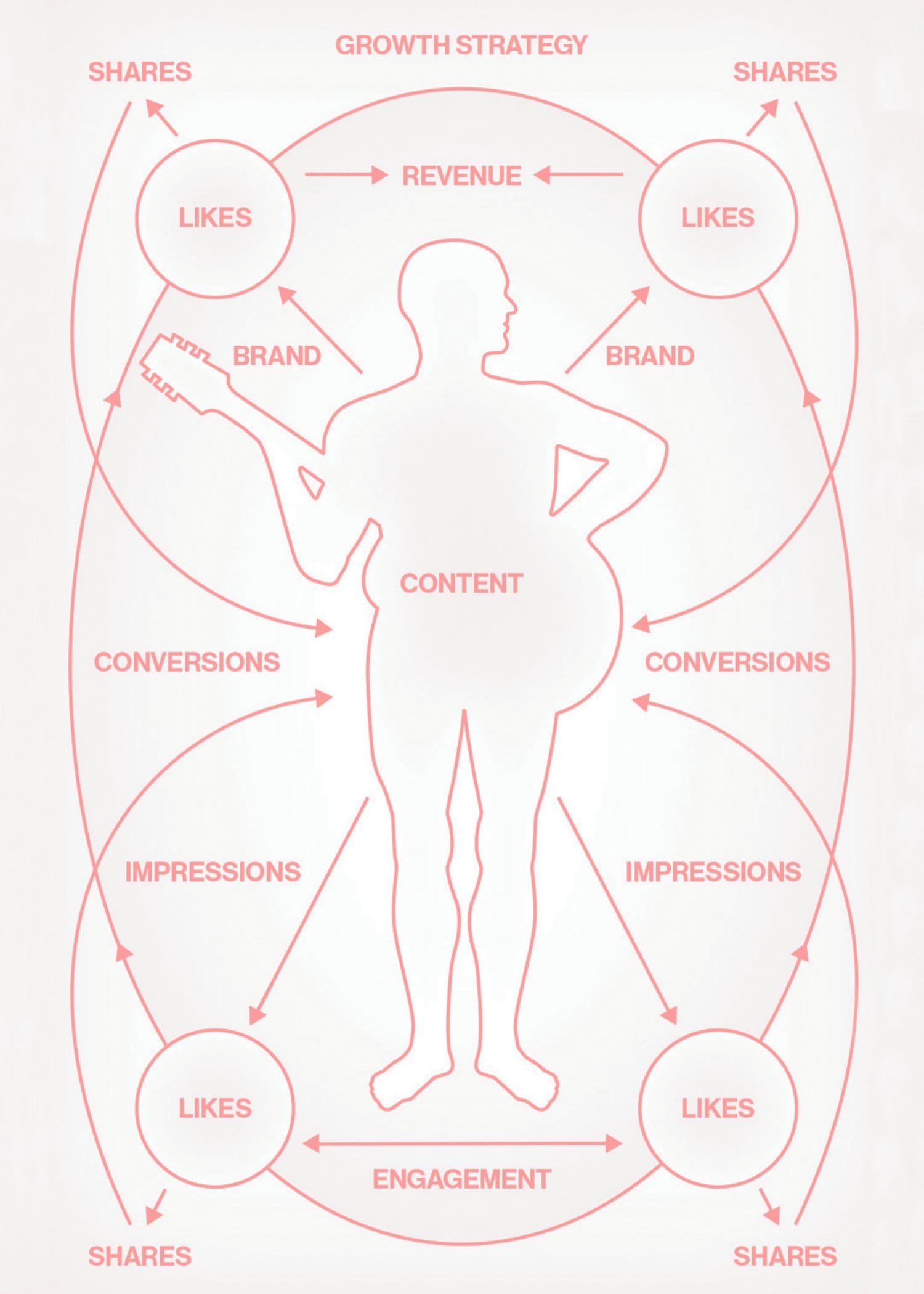
XXVIII. under the influence / finding perspiration
A good way to strengthen your musical practice is to reflect, absorb, and digest other things. Copping to your influences is a spectrum.
On one end, you have people who wear their influences on their sleeves so much, they may as well be tattooed all over their arms. Their adulation and adoration for their favourite artists borders on the absurd, and sometimes goes to such extremes that their work lacks an identity of its own and becomes an imitation of what came before them. A map of a map.
On the other end, you have artists who claim to be completely self-contained and self-sustained, who say they draw inspiration from nowhere but their own inner well, and who, in no uncertain terms, are full of shit.
Some artists are completely immersed in influences from within their own genres, and only listen to music from those genres, and essentially live in a closed loop. In other words, if you are a rapper and you only listen to rap, there’s a chance that one of your peers or influences is bringing in non-rap elements into their work, but your absorption of that is second-hand at best. When artists only consume within their genre and make music within that genre, they run the risk of just producing simulacra. Again, their music can end up sounding like maps describing a territory that doesn’t actually exist. The maps have been drawn so many times they seem true, but then again, almost anything can seem true if you are shown it enough.
A more fruitful approach could be to look outside of your immediate sphere for inspiration to draw from.[[20]] The possibilities are endless. No matter what genre your music exists in, you can learn infinite lessons from other genres that will allow you to enrich what you do in your own. You can learn something about atmosphere from the tremolo picking of black metal, be influenced by propulsive rhythms from the compressed drum machines of late 80s hip hop, and find inspiration for song structure from sprawling prog rock songs.
Those are just a few examples of how you can keep your ears open to things that might help you develop new avenues in your practice. However, there’s no need for the process to feel like homework: life is short and there are only so many things to listen to. Be judicious. Be ruthless. But above all, try to have some fucking fun. And if you can’t listen to or find anything worthwhile in music outside of your favourite genres, you are, in no uncertain terms, a stuck up fuddy-duddy.
Of course, influence and inspiration doesn’t just have to come from music. In fact, it’s probably better if music isn’t your only source. Try to imagine how your musical practice might be influenced by architecture, by the feeling you get from certain colours, or by the rhythm of a particularly heated conversation. Imagine how your music could be influenced by how fire eats through a thick piece of wood; imagine how you could be a musical complement of a sandstorm.
It’s not necessarily about finding something worthwhile in everything. It’s about finding something in everything that you think is worthwhile. Take time to dig into what you love. See what comes out, and watch horizons expand around you.
XXIX. criticism
I want it. I need it. Because all these records, they give me a language to decipher just how fucked I am. Because there is a void in my guts which can only be filled by songs.
— Jessica Hopper, “I Have a Strange Relationship with Music”
Closely related to influence is critique, and it’s cruder cousin, criticism. Rather than try to tease apart the differences between the two, I’m going to start by saying that, given the absolute glut of material that exists out there to be listened to and considered, and the dearth of music journalists doing anything of value, the chances of you getting meaningful critical engagement with your work in a public forum is going to be an uphill climb. When it does happen—when someone you don’t know takes the time to digest your work and offer honest and engaged feedback—it’s going to feel really good, even if it’s not glowingly positive.
The reason it’ll feel good is that, after all of that proverbial shouting into the proverbial void, having a signal come back to you, any signal at all, that seems to say “message received,” feels like a blessing. And if you’re fortunate enough to get that kind of sincere feedback, positive or negative, it is a goddamn blessing. For artists with an active, engaged practice, criticism can help to illuminate corners of your work that you didn’t know existed.
Unfortunately, by and large, music journalism is a morass of favour-buying and payola, dominated by a species of leeches who call themselves “publicists” and “public relations firms.” These are people and entities who generally stand between you—someone creating honest work—and cultural critics, whose time is extremely limited. These people act as a filter, gatekeeping publications for hefty fees, and promising placement in publications for the right price. You can look at them as a necessary evil, but don’t let that take your focus away from what they are: fucking evil. They may not be bad people, and you may not have anything against this process per se, but try to remember that, regardless of your feelings, this structure is set up to throttle access through financial payoffs.
It’s also worth noting here that many music journalists are fucking hacks. They may be hacks with good intentions. They may be hacks who really love music. Many of them are even practitioners themselves. However, the vast majority of the field is populated with people who are very happy to coast on copy and paste press release pabulum, and surface level analysis.
All of that is to say, well-thought-out criticism is fucking rare, and it’s something you should nurture, because it’s so rare. This doesn’t mean that you have to suck up to people who review your work, or go out of your way to have work reviewed, but it’s worth taking the time to shout out and thank those that do. Further to that, keep a list[[21]] of the people that really explore and take the time to engage with your work, and be sure to send them more. Chances are, if they’ve given you their time in the past, they may do so in the future.
I can’t emphasize this enough: we live in a time where there is just a massive fucking glut of material out there, and the number of people who take on the role of cultural critics—and do so with passion and integrity—are like beacons on the choppy sea. They don’t necessarily tell you where to go or how to get there, but they do offer a sense of the shape of the rocks below, and in the best circumstances, they can give you a sense of how seaworthy your boat is.
Finally, it’s worth noting that sometimes, the best source of critique you have may already exist in your own circles. Remember, we’re now adrift on a smaller boat, and under ideal circumstances that boat should be populated with people who help you to survive and sustain through support and encouragement. In return, it’s something you can offer back.
One example of how you might do this would be sharing your work within a small inner circle for feedback before you push a given project forward. This could happen before mastering, before mixing, or even at the demo stage. Those within their circle could hear the work, ask questions, outline potential problems, speak to what moves them, and give encouragement as needed. They could give feedback on layering, mixing, and the particular sounds of instruments and voices. In later stages, they could offer ideas on how the work could be packaged and presented to the public. You could ask them for very specific feedback on certain things, or general feedback on everything. It could take many different forms, but this kind of critical inner circle would ultimately function on honesty, mutual respect, and a good dose of kindness.
Ideally, each person in such a circle would feel equally empowered to participate in this process, whether as the person sharing work, or one of the people giving feedback. If you can find a circle of fellow artists to take this exchange seriously, you will be amazed at the kind of awesome shit that can come out of it. I promise it’s worth it.
XXX. generic horseshit / resisting genre
Rock. Jazz. Punk. Dada. Beat. These words and their longer cousins, the ism family (surrealism, postmodernism, minimalism, etc.) are used to commodify and commercialize an artist’s complex personal vision. This terminology is not about understanding. It never has been. It’s about money. Once a group of artists, writers, or musicians has been packaged together under such a banner, it is not only easier for work to be marketed – it also becomes easier for the audience to ‘buy it’ and for the critic to respond with prepackaged opinions.
— John Zorn, Arcana
I know that I’ve been using the word “genre” throughout this text as a shorthand for the rough grouping of artists under different umbrella terms, and I’ve even used some of these umbrella terms to get at certain ideas.
It’s hard to know when the modern concept of genre started, but you can be almost certain it was a marketing decision. By separating music into relatively discrete genres, it allows people to use those discrete slices of supposedly similar sounds as a way to remain in a lane. If you’re a “rock aficionado,” and you go into a record store (or hell, navigate to a streaming service) and begin to browse things labeled “rock,” there are a certain set of textures and sonic flavours that you can probably expect to hear. It reduces the chances that you may hear something unexpected. Now imagine a record store had nothing categorized by genre, or even alphabetically. With each flip of a record, you wouldn’t know what to expect, at least until you saw the cover (and possibly not even then).
Genres are the reason why it might be jarring if your favourite metal band release an album of acoustic music, or if a jazz ensemble you like experiments with noise, or if a hip hop artist you’ve followed for years suddenly releases a rock album. These types of experiments are often looked at as a novelty, a cute little aside, not to be taken seriously.
But, that’s looking at genre as a listener. What about the experience of genre as an artist?
There are some good reasons to embrace genre as a way to define yourself. If, like me, you’re an artist who functions well within some type of boundaries, genre can be a way of setting out a sandbox for yourself. Genre can give you a framework within which you can explore your inner self and outer limits.
Secondly, genre can be a useful structure within which to network with other artists and market yourself. Note that this doesn’t have anything to do with musical practice, and is a decidedly commercial perspective. Still, it’s worth emphasizing: playing by the rules of a particular genre (or genres, if you’re looking for that sweet crossover) can help to package your artistic output in a way that has some kind of coherence for the general public. The framework of genre provides a lot of shortcuts that you can use as needed, to resolve certain question marks. If you’re an electronic music act, or a metal band, or whatever, the visual and auditory touchstones of those genres can help you when you get stuck and don’t know what to do aesthetically. Playing within that framework will make your work much more accessible to the people that enjoy that genre.
Of course, there are a lot of legitimate and worthwhile reasons to resist genre, whether it’s applying it in your artistic practice or using it as a way to market yourself. That second one, the way genre functions as a marketing tool, should be reason enough to be skeptical of it. Fuck it, you know what? The way genre functions to limit sound should make you skeptical and resistant to it as well.
What does it actually mean to resist genre? It means that you need to engage in the creation of music from a place of feral honesty, and that requires a degree of self-awareness that a lot of people—maybe most—don’t have. You need to dig fucking deep and imagine that you have an infinite sonic palette. Forget about the practical barriers to that for now. Imagine what kind of sound you would want to make if you had no barriers.
The vast majority of artists are capable of finding beauty and inspiration in a wide variety of places. Not all of those sources may be part of the soup you wish to brew in your cauldron.
However, resisting genre means that nothing should be discounted outright.
This process is sometimes referred to as “finding your sound,” and that’s definitely a turn of phrase that’s been tossed around a lot in a pretty lighthearted way, often about musicians that are “just starting out.” However, the process of “finding your sound” could (and maybe should!) be seen as an ongoing process, whether with each new project, each new release, or each new composition.
Earlier, I talked about plumbing the depths, of reaching deep down and trying to find that briny water to pull up, distill, and evaporate down to a salt. You can think of finding your sound in a similar way: it’s a constant and ongoing process, and the further you go with a particular project, the deeper you will need to dig to find your sound.

XXXI. touring
I’m nobody! Who are you? Are you nobody, too? Then there’s a pair of us—don’t tell! They’d banish us, you know. How dreary to be somebody! How public, like a frog To tell your name the livelong day To an admiring bog!
— Emily Dickinson
A good way to stretch out the musical horizon before you is to tour. Yes, touring is also a great way to hang out with your friends and have a grown-up iteration of a summer vacation, but that’s not what I mean. I’m also not so much talking about “playing out of town shows,” one at a time. I mean packing up a vehicle, and casting off for a while, whether it’s three or four days, or three or four months.
Now, in the unfolding of the story of The Helvetica Scenario in previous sections, the financial reality of touring that I described was relatively hard. Yes, you can make some good money doing it, and if you know how to scale things up in proportion with a dependable audience, you can earn some decent money for your efforts. It’s likely not totally proportionate to the amount of actual hours (writing, recording, rehearsal, etc.) that you need to put in to get there, and it’s still a constant grind, but it sure does feel nice to get to that plateau. If you don’t have a record advance to pay back, it may be even better.
Down here at sea level, touring should be[[22]] less about making money and more about gathering experience. If you plan well and work with good local bands, you can and will break even, and you can even make a good amount of money—but forget about all that for a second. I want to talk about why you should go on tour, and what it can do for you as a practitioner.
Going on tour is hard to describe to someone who has never done it. Even if you have, bear with me: you travel from town to town, you work with local groups in each town you go to, you play venues that you’ve likely never played before, you sleep in strange places, you make and lose money, and you meet a lot of new people. The music that you’ve been incubating at home is presented for the first time to people who have likely never seen you, and possibly never even heard your name. Those people may not see you again for weeks, months, or longer. In many ways, it’s much more vulnerable[[23]] than playing shows in your hometown, and that vulnerability can lead to some very high highs, and some very low lows.
Why touring is important is that, up until now, I’ve been describing how to sustain and survive by building something of a magickal, protective circle around you and your practice. In a lot of ways, touring requires you to leave that circle and venture out in search of uncertainty. If you want to evolve as a practitioner, it’s important to take risks often as you can. Touring involves committing yourself to vulnerability, mythmaking, and risk, and all three of those are potent fuel that will help to propel you forward into new areas. What’s more, touring helps you refine how you perform and present your work, and can help highlight problems (and solutions) you’re unable to see from within the circle.
One of the first things you’ll notice about going on tour is that, in subtle ways, people look at you differently. Part of this is because you’re literally a stranger. Part of it, however, is because you’re a traveller, on the road, trying to bring magick to a new place. You may already be familiar with this look; you’ve probably looked at touring bands coming to your town the same way.
You get to a new town, and over the next few hours, you will load in your gear, soundcheck, sit in the venue, talk with people, play your set, talk with people, pack up, load out, talk with people, find a place to sleep, and then wake up, drive, and repeat the process all over again the next day. It’s a somewhat reliable and tumultuous routine that is by turns invigorating and exhausting. Whatever it is at any given moment, touring is very much that. When it’s exciting, it’s very exciting. When it’s boring, it’s very boring.
Yes, touring is not always a good time. It’s often tedious, and mind-numbing. There is a certain kind of routine within a lack of routine, and it’s easy to become inured to the whole process. The challenge is to approach each performance—which usually means each new town and venue—as if it were the first. To survive touring, and even thrive under the sometimes harsh circumstances, you will need to find ways to make the circumstances not just bearable, but exciting. You will need to figure out ways to find positive perspectives on bad situations, and that is going to take some serious fucking humility.
There is nothing quite like the hit that your ego will take when, after five good shows in a row, you end up playing to an empty room on a Friday night 1,500km from home, as the venue owner or booker and the staff look at you like the asshole who’s making them lose money. There is also nothing quite like the feeling of being somewhere you’ve never been and playing to a full room, and having people shower you with praise after you finish your set.
It takes a thick skin and, dare I say, some serious fucking grace, to be able to navigate the various ups and downs of touring with a calm and equanimous mind. It’s very difficult, but to make it sustainable, it’s essential. You need to not get too discouraged, or pat yourself on the back too hard. You need to remember that, even if no one is there, it doesn’t mean they shouldn’t be. You also need to remember that, if everyone is there, they might not be next time.
There is no one way (or right way) to maintain your core motivations and intentions when out on the road. I will say that what works for me is generally a) going it alone, b) finding quiet and calm places to sleep post-show as opposed to “party” type situations, c) avoiding excessive alcohol for both practical and emotional / spiritual reasons, and d) motherfucking podcasts. That being said, I am a generally introverted extrovert, meaning that I am gregarious, but need a lot of time to myself to recharge my batteries. If I’m able to get the right amount of time to myself, I am very much able to “show up” for all of the various things I need to be present for while on tour.
You may find that different strategies work better for you. Experimentation is needed, and it may take some time to find your ideal touring style. There is almost no avoiding a certain amount of burnout from touring, but there are ways to mitigate it. Most of all, it requires discipline and, as with everything, a great deal of self-awareness to remain grounded through the process.
XXXII. you are not what you own, but you are what you sell
In nearly every artist’s trajectory, there comes a time when they must decide not only what they plan to sell, but how they plan to sell it. This includes everything from albums, to apparel, to the various other sundry things that music has been attached to.
Before we go further, let us break this into two streams: the first is a look at selling physical representations of music, as in records, tapes, CDs, and so on. The second is a look at selling other physical things that may or may not have some kind of immaterial music—like a download code—attached.
Selling physical representations of music is fairly straightforward: you need to decide what format you would like to release your music on, including what format may be most appropriate for the music in question, and then you need to think about how to package that product within the general conventions of that format. If it’s going to be a tape, you’ll want to think about how the cover artwork will wrap around a J-card, and maybe how the plastic shell of the cassette itself may match a colour from that artwork; for CDs, you’ll want to think about similar things, though there are different options for cases, everything from clear jewel cases to chipboard foldout thingies; for an LP or a 7”, you generally have more space for artwork, and you can think about how the various parts—the label, the sleeve, and the jacket—may work together to present something that’s greater than the sum of its parts.
All along the way, you need to keep the spirit of the recording itself—the actual music—in your gut. What does the recording demand of you, in terms of presentation? Of course, you’ll probably always want to do more than you have a budget for—start with blue-sky ideas with no concern for budget, and then triangulate things down to the right cost/presentation ratio(n) that you can work with. The main point here is that the way you present your music and the attention to detail that you bring to the table speaks volumes about what you think of the music itself. Again, there’s nothing wrong with DIY presentation and home-made packaging, but if you choose to package your musical representations sloppily, they will probably be treated as such. Do you really fucking care about your music? Are you proud of what you’ve done? This is one of the most important places to show that. Attention to detail is key.
Secondly, because most music is basically vapour now, there is a growing trend of many musicians[[24]] selling bits of merchandise that are not direct musical representations. They may be bars of soap, decks of cards, gameboards, puzzles, lampshades—whatever—and with those objects, you include a download code. This is by no means uncharted territory, but I hesitate to give it too much space. Anyone going down this stream should do so with caution: there is a lot of white water and there are quite a few rocks that you can be dashed upon. A big challenge with this stream is that it doesn’t take much time at all for the whole exercise to become quite abstract, and to lose sight of the fact that what you’re actually trying to sell is music. As with tapes, albums, and CDs, when you do this type of thing, you really want to think about how the physical object you’re creating is an extension of the themes of the musical document itself. Ideally, you want the music to dictate the ideal form of the object, and not the other way round.
Having had several dalliances with “alternative merch,” I can say that it has the potential to be very powerful and attract new people to what you’re doing. It also runs the risk of working against you: maybe someone just buys the puzzle you’re selling because they like puzzles, and could care less for the music. Is that a good thing or a bad thing? I’m honestly not sure. It feels strange to sell an object that someone likes more than what the object is supposed to represent. But then again, you feel lucky to have sold something. Weird world, eh?
As for the rest of the stuff musicians sell, we can broadly lump that all into the category of apparel: t-shirts, hoodies, hats, whatever—stuff that you wear. I don’t know when artists started selling clothing, or why, but it’s a bit strange, isn’t it?
Some artists really make a point of selling clothing, and lots of it, almost to the point where it feels like they become a clothing line / brand in and of themselves. There is a lot of money to be made in clothing, even if all you ever sell is t-shirts. And, to be sure, selling shirts can help keep you afloat on tour, turning a potential “loss” of a night on tour into a gain. However, making shirts, and thinking about how to sell them, is energy spent away from music proper, so give those activities your attention accordingly.
A good rule to follow in how you make apparel (and all merch) is a variation of the golden rule: do not sell something you wouldn’t want to buy from someone else. If you don’t buy CDs, you may consider not selling them. If you only buy t-shirts of a certain quality or fit, you may want to put the effort into offering people that same quality. Your own threshold is a great guide, because if you satisfy yourself—to whatever level that means—you will automatically feel proud to offer that to others.
In this year of our lord ____ (pretty much any year from 2016 onward into the future), the people that are buying your merch (including all manner of objects discussed above) really want to support you. There aren’t a lot of people out there buying records for shits and giggles, or paying for your shirts at some Wednesday night show just because they don’t have anything else to spend money on. Keep this in mind as you set out to sell anything: someone who is buying something from you is taking the first steps of building a relationship with you and your work, or actively working to continue growing that relationship. Each thing they take home is going to remind them of your performance (and hopefully your music) every time they look at it. What is the feeling you want them to have at that moment? How do you want them to remember you, and how do you want them to feel connected to you?
XXXIII. training the audience / being the audience
In a general way, our culture tends to look at “the crowd” as a kind of amorphous thing, a large collection of silhouetted heads, perhaps with their arms stretched skyward in adulation. That’s another one of those brightly-coloured balloons that we should pop now, with gusto.
Part of making your musical practice sustainable (both in a live setting and otherwise) will be building a relationship with your audience. You will find out very quickly, if you haven’t already, that they aren’t just a bunch of heads. In fact, for a good portion of your early career (and perhaps your whole career), you’ll be able to know many of your audience members by name, without too much effort. This is a good thing.
But, it’s also not a bad thing when your audience grows past this point of recognition. In fact, it’s one of the biggest thrills you’ll ever have, a high that feels worth chasing: the feeling when you find out that someone you don’t recognize and that you’ve never met before loves your music. In some ways, it’s the very essence of why you might do this: to feel a connection, and when that connection comes from a stranger, well, there’s just something fucking cool there that’s hard to articulate.
However, as your audience grows organically, the way that you connect with them will become more abstract, and part of your job is to find ways of grounding that abstraction in something real. A key way to bridge some of that gap is something the corporate world calls “expectations management.” This is a fancy way of saying “consistency.” Strong relationships are forged in some manner of consistency. This can mean a lot of things, but what I mean is that you want your audience to know what they can expect from you, even if that means they can expect only chaos or experimentation.
This applies to recordings, live shows, merchandise, all of that. But it also applies to other things, like how you treat venue staff, how much you discuss your work online, how much information you provide your audience about your process, and so much more.
Consistency means that you treat every performance with the same intention, not wavering depending on the quality of the venue or the fullness of the room. Consistency means knowing what the essence of your work is about, and bringing that to each piece of merchandise or other representation of it; consistency means bringing that same energy to every aspect of what you’re doing. It’ll help your audience connect with you by letting them know that, no matter how they are feeling, what you’re bringing to the table will be of a similar value each time. And if you’re building that kind of relationship with an audience, you can assume they think that value is high.
Something that will help you be better to your audience and forge meaningful connections with them is understanding yourself as an audience member as well. When you go to a show, what do you ideally expect from the artists? When you buy a recording or a garment, what do you expect in terms of quality and feeling? What makes you really connect with an artist that you love?
It’s worth noting here that, even though you’re trying to build a relationship with your audience, this relationship should only be given credence as a thing of value for as long as it is strengthening you. The moment you start to become beholden to your audience, you’re going down a dark river that will be hard to paddle back from.
But wait, didn’t I say that you want to promote consistency, that you want to make connections and that you want to strengthen bonds? Doesn’t that work against the idea that you should disregard the audience and not be beholden to them?
Yes, to all of that.
There are deep contradictions running below the surface of the relationship between artist and audience. Engaging artists usually know how to work with those contradictions and tensions in a way that feels natural, playful, and antagonistic, often all at once. It’s a certain alchemy that is very hard to articulate and elucidate, because it’s entirely individual. No two artists work that magick in the same way.
Ultimately, when you think about your relationship with your audience, you want to think about the message—I don’t mean a political message here, though it could include that as well—you’re trying to send. Then, you want to reverse your perspective to think about how that message—musical, lyrical, experiential—will actually be received. There’s no need to play to the lowest common denominator here; you don’t need to grind what you’re trying to communicate down to be understandable by “the most average listener.”
It may be hard or impossible to do in the momentary mania of creation, when you’re creating and birthing a given composition or larger project. But, it’s very important that you think about what you’re doing and how it will be received by people outside of your head. You need to think about what you’re doing from the perspective of a person engaging with your work, and if your intended message will come across with the cues and gestures you’ve made.
The best relationship you can possibly build with your audience is three-dimensional: the first dimension is intensity, the second dimension is honesty, and the final dimension is clarity. I leave it to you to imagine that relationship with your audience as a 3D object, a physical thing with texture and shape, that you must tend to as part of your practice.
XXXIV. deal or no deal
We always had said that we were just not interested in what’s on offer, which is that they’re buying the name of the band, they’re buying the control of the band. And we decided that there was no price that would be worth it to us to cede that control. I always feel like you hear these stories about people like they’re really… idealistic or whatever, and then eventually, a price is named and they say, “OK, well let’s take that.” Don’t you wanna hear the story where they never said yes?
— Ian Mackaye, on WAMU Radio, 2014
Though I’m sure the last thing you want to revisit is more talk about “record deals” and “getting signed,” it’s worth giving it one last look. Last one, I swear.
Part of what drives musicians to seek deals out is the alluring promise that the most tedious and detached aspects—The Industry parts—of music will be taken care of for them: promotion, accounting, distribution, order fulfillment . . . all of those things that the vast majority of artists hate doing. And that is a hell of a promise, to be sure.
Though I’ve spent a fair bit of time describing why you might not want to take a deal, even why it may be foolish, it’s worth saying that, having a deal may help to make things sustainable for you.
There’s also a good chance it might not.
The main thing to remember about deals and contracts is that, no matter how good of a deal both sides feel they get, no one enters into the process thinking they want to “lose” anything. Inherent to the process of a deal is a negotiation of how the proverbial pie will be sliced up, and of fucking course, both sides want to feel like they are coming out on top in that process. Fairness is a concept that may enter into this equation in an abstract way, but it’s rare to find two people who have the same definition of “fair.” It’s a process that you should enter with caution, and a protective spirit for the magick you’re bringing to the table.
There are many good labels run by many good people, and should you be fortunate enough to find yourself dealing and dancing with such kind-hearted souls, count yourself lucky and hold on for dear life. Most of all, remember that a label relationship is like any other, and if you ever feel like that relationship has turned toxic, it’s time to make for the exit with expedience. Here’s hoping your contract will allow you that flexibility.
XXXV. how you do anything is how you do everything
At this point, some of the various trains of thought threading their way through the different topics discussed here may have started to sound very familiar, even repetitive. I hope so, actually. There has been an overarching theme here, a beam of light arcing through the mist hanging in the air above all of these choppy waters, and it’s this: how you do anything is how you do everything.
Surviving and sustaining yourself as a practitioner of musical magick means recognizing that there is a profound intersection at the corner of intention and effort, and that’s where you sit at all times. You get out of it what you put into it, and building momentum requires even greater attention, and of course, more intention and effort. Are you tired yet? If you’re doing it right, you will be tired for sure. But what you get out of it will also be propelling you forward in a way that is hard to describe. And it will be fucking worth it.
Sometimes, being a musical practitioner can feel like your body is just flesh animated in the service of the sounds inside of it. It can feel like the only thing that’s real is when you hear your music come through the speakers at an uncalled-for volume, and when the bass pounds in your chest, you’re free. When a room falls silent and they are hanging on every note, it can feel as if that’s enough to sustain you for hundreds of kilometers to the next city.
To access those fleeting moments of spiritual freedom takes incredible effort; if your goal is to make that process financially sustainable as well, you will need to have double[[25]] the wherewithal, and often be willing to set aside some of your truest intentions to make that happen.
What I hope I’ve been able to do in the preceding text is to offer you some ideas for how you can make navigating through these choppy waters spiritually sustainable, because that’s the path where what you put into it is what you will be guaranteed to get out of it. Financial sustainability is a much more difficult and rare thing, and will inevitably lead to bargaining, to get the best deal possible in the trade-off between making art and making rent. In case it’s not clear by this point, I think music and creativity has a value and power that is far deeper and far more valuable than money. Though my sincere wish is that every musician who is true to their art could sustain themselves financially from it, I hope what I’ve offered are some strategies to help you stay connected to that power, regardless of what any balance sheet says.
You don’t have to be a gambler, playing the lottery with something that is so valuable to you. You don’t have to travel along on that creaking and leaking Ship of Theseus, with all of the others, living in the lower holds, losing their minds on the deck, replacing planks and shoveling coal to keep the ship going, all for the benefit of people eating steak in the dining room on the upper deck.
It is possible to set out in your own lifeboat, and survive, and sustain. You can go forward in a different way. You can find your own path, using your own map.
Begin it now.
XXXVI. with Leviathan
Deep down in the sea, well below the surface, is Leviathan. The great monster has been there all along, and will be there long after we’re gone. Even after the Ship of Theseus has come apart at the seams, even after THE BEAST has fallen from the sky and the clouds have dissipated, even after our small boats float off across the horizon line, Leviathan remains.
We started this journey at different places, and as we all learn to navigate the waters around us, we might drift apart further, or come together. Maybe we’ll press forward in a small flotilla, helping each other along for a while until fate and intentions necessitate a mutually agreed farewell. Or maybe we’ll never meet, but we’ll communicate with signal flares shot up into the night sky.
It’s hard to remember sometimes that music existed before The Industry. They have done such a thorough job of commodifying our magick, that our history as practitioners has been obscured beyond recognition. If we believe their story and buy into their maps, they want us to think we owe them our magick in exchange for being entered into a rigged lottery.
But these waters belong to Leviathan. The magick that we practice and what we’re able to call forth with our spells comes from Leviathan. Our hopes and fears belong to Leviathan. Our small life rafts are in the care of Leviathan, and their Ship Of Theseus, chugging along and leaving filthy bilge in its wake, will someday become food for Leviathan.
And in the end, Leviathan remains.
Leviathan
we have become water
we await yr return to our surface
watching reflections ripple and shear
we are preparing gardens for you
gardens fenced with bones and
watered with blood of charlatans
it is the least we can do

besides
Music is everything to me. But besides that, everything is music, too.
As a way of closing this text, I’d like to share some ways that you might think about music when you’re not making music. I don’t mean that you will be thinking about melodies and lyrics and rhythms as you wash the dishes—I’m sure you do that already. I mean that I’d like to look at some activities that aren’t musical in nature, but contain plenty of ideas and actions and intentions that can be translated into a musical practice.
More than the previous text, this next section is personal. These are things that have opened up my mind and given me perspective on my own musical practice in ways that I didn’t expect, and in ways that have stayed with me long enough to remember them now. I don’t know if all of these, or possibly any of them, will work for you. But they help me immensely.
XXXVII. one foot in front of the other, forever
Some [running] sessions are stars and some are stones, but in the end they are all rocks and we build upon them.
— Chrissie Wellington, Triathlete
I started to write this text as part of a larger project that included a one-time 8hr endurance performance, and part of my preparation for that performance was to take up running. I had tried running before, with varying levels of success,[[26]] but this time, I knew that I needed to build my endurance, and that I had no option but to make it work.
I started slowly, running for 2km, 3km, 4km at a time. I tried to set goals for myself each week to try to reach new plateaus: One week I would break 5km at a clip, the next week I would try to get to 7km in a single run. Eventually, I would break 10km, and at the time of this publication my longest run was a half-marathon.[[27]] It was a slow, sometimes excruciatingly slow, incremental approach that made me feel like I was making progress, but also not pushing myself to the point of burnout. At each plateau, I could not believe that I had gotten there. I tried my best to take care of myself throughout this, massaging icy-hot cream into my knees, eating popsicles to hydrate, stretching, and even just making the space in my schedule to fucking do it, even when I was tired and really did not fucking feel like it.
Mechanically, that’s generally how I made it work. But that’s not the part that makes me think about music.
The same way that there are no shortcuts to listening to a piece of music, there are no shortcuts to running. You want to listen to a 12min piece of music or a 75min album? You have to give it that much time. You want to run 10km? There is no way to do that which doesn’t involve running that distance. It’s an embodied process that you must exist through.
Relatedly, running has taught me a lot about digging deep. It is a deeply personal activity that you can’t do unless you listen to your body, and figure out how to come to peace with your inner monologue. To physically run long distances, you need to listen to your body and feel what’s happening to it as you go along. To mentally run long distances, you need to be very comfortable with your inner monologue, at its best, and at its worst.
Many people talk about “runner’s high,” the endorphin rush that helps you along as you run for long distances. It is a real thing, and though it certainly does feel amazing, I haven’t really found that it propels me or inspires me to run. To be honest, I don’t think that high is worth the effort it takes to get there. The pain and difficulty of running, on the other hand, is immediate and real. I don’t need to run more than a few blocks to start to feel it. The runner’s high feels ephemeral, while the difficulty of it feels concrete, consistent, and very fucking real. It’s grounding and reminds me that, while it might be easy sometimes, it’s not necessarily supposed to be easy.
XXXVIII. nutritional alchemy
Cooking is like love. It should be entered into with abandon or not at all.
— Harriet Van Horne “Not For Jiffy Cooks”
This section of writing about cooking and music will make me the 1,000,000th person to ever do so, which I think weirdly qualifies me for some type of prize. But, I hope that, rather than talking about the interplay of spices or jazzy improvisation in putting dishes together, I can take a different tack here. I call it alchemy, because in cooking I see the ability to transform matter, to wring proverbial gold out of proverbial lead. I see the transformation of base materials into noble compounds. I see magick and intention in the entire process.
For me, cooking has always been less about jazzy improvisation and more about recipes and spell-casting. I like to follow recipes and discover what the food alchemist intends to be made, and then modify the recipe over the course of many, many iterations. I love to hone in on the intentions of the original spell, and then see how it can be altered and shaped to my own personal tastes and intentions.
There’s also an element of drafting that cooking helps me to wrap my head around. It’s a really good example of how slight adjustments in the mix can make a big difference.[[28]] And, as with music, I don’t by any means consider myself a cooking expert. But I am a committed enthusiast, and I find equal enjoyment in trying new things or playing with old standards.[[29]] Presenting food has also become a real joy of mine, because I realize that without a good performance, the excellence of the dish can be lost.[[30]]
Had enough of the puns and metaphors yet? This is why trying to write about cooking and music sucks: the two acts so obviously lend themselves to cheesy[[31]] wordplay when being discussed together. And everyone has already done it. But, all of that aside, cooking is one of the ways that I’ve really connected with music. I often listen to music loudly when I cook, and because cooking can be somewhat of an “autopilot” activity for me (in a meditative sense), I feel that it gives me a chance to really listen to records as I craft a meal.
Anyhoo, cookbooks are also some of the only remaining spellbooks we circulate openly amongst each other. Disregarding all of the above, I think that fact alone is worth thinking about.
XXXIX. something from nothing
Planting seeds and growing plants is something that I am very new to, and in many ways, I’m still a spectator. I recently had my mind blown by having the privilege to observe and participate in my partner’s garden. I feel ridiculous saying this, but it was the first time since I was a kid that I ever actively watched something go from seed to flower.
Watching the garden grow has been a stunning example of how small decisions in the present lead to very specific consequences in the future. You decide where to plant something, and you help it survive in that spot as best as you can. For a while, it seems like nothing is really happening, and then a new branch or leaf just shoots out of nowhere. For a long time nothing happens, and then it happens all at once.
There is an art to the cultivation and tending of plants that I’m just learning about. It’s a long process of recognizing big question marks and trying to plan for chaos. It’s a process that involves unexpected outcomes and strange, wonderful trade-offs of energy. It’s also a process of watching practically imperceptible changes build up into meaningful differences.
Looking at my partner’s garden, I’ve watched tiny tomato seedlings turn into monstrous, gnarly bushes, bursting with fruit. I’ve watched how a day without water can start to wilt leaves and make the plant turn inwards for protection. I’ve watched the local wildlife take what they need (and a bit more) from the garden, while they mostly abide by a shared, imaginary, contract to not take so much that everything dies.
Just a few feet away from the garden, I’ve watched torrents of rain water the sidewalk, calling forth tiny sprouts of out of the concrete. No matter how many times I see that shit, it never ceases to amaze me.
acknowledgements
Sections of this text sample liberally from The Problem With Music, an essay by Steve Albini. This text also owes a great and particularly weighty debt to Mark Molnar, and his 2017 talk in Peterborough, entitled High Water Everywhere: a workshop for artists.
Special praise is due to Alex Unger who provided extensive and intensive feedback and copy editing, and helped to edit a mess of a first draft into a second-take miracle. Similar but unique praise is also due to Mark Molnar, who provided extensive feedback and helped set some ideas into further context.
Furthermore, this text could not have been put together without the patience and care of Laura Thompson and Raoul, and to a lesser extent, Jasmine and Bluebeard. This text also benefited greatly from the feedback and encouragement of Bennett Bedoukian, Matt Jarvis, Satah Cameron, Kate Story, and Ryan Kerr.
I could never put something like this out into the world without thanking all of the homies in Skelt Krew, who know who they are. Thank you.
This first print edition was partially funded through a residency at the second iteration of Precarious, a festival exploring issues of arts, labour, and precarity, that takes place in Peterborough / Nogojiwanong, Ontario.
This book has been printed by Vide Press, an independent risograph press based in Toronto.
credits
Alex Unger
Mark Molnar
copy editing, narrative guidance
Bennett Bedoukian
Laura Thompson
design guidance
Laura Thompson
author photo
Giga Kurtsilava
front and back cover photo
Jeremy Bishop
Jaroslav Devia
Ian Espinosa
Peter Feghali
Katie Moum
Cristian Palmer
Johan Rydberg
Marc Schaefer
Jason Tuinstra
Serkan Turk
inside photos
Robb Mirsky
skelt krew logo
all photos used with permission.
about the author
garbageface is an artist based in Peterborough / Nogojiwanong, Ontario. For the past ten years, he’s been creating and performing music under this moniker as a way of exploring his subconscious and subcutaneous feelings and impulses. Since 2009, he has put out more than a dozen releases, ranging from ambient, digital-only field recording EPs to conceptual rap LPs about Eastern European folklore. In that time, he’s also toured the U.S. and Canada numerous times, clocking over 325 shows at the time of publication. This is his first book.

[[1]]: Usually worse... but not always.
[[2]]: The way we hear music is particular to Earth. If you could play music on another planet and hear it in that atmosphere it would sound very different.
[[3]]: And vice versa.
[[4]]: Some of these are moot points if you play music that has been designed as a soundtrack to excess or intoxication. There is plenty of that kind of music, and plenty of music that is very, very far from that.
[[5]]: If we’re being honest, they are mostly financial. Ask yourself, what kind of media and packaging would you capture your music in if money were not part of the equation?
[[6]]: I’m going to do my best to use general terms rather than talking about specific companies existing in this moment . . . because even when the companies of today die off, and their carcasses are consumed in the maws of new companies, it’s likely that similar forces will be at play.
[[7]]: The entire section that follows borrows liberally from the basic ideas contained in Steve Albini’s 1993 essay, “The Problem With Music.”
[[8]]: I know some of you are balking already. $20,000 to make a fucking record? Yes. If you’re not used to spending that kind of money, it seems ridiculous, but this is a reasonable budget to record a full album, with a full 4-piece band, and see through a professional mixing and mastering process.
[[9]]: Though the band act as their own booking agents—literally, booking the venues themselves—they still have to work with promoters in each town. A promoter is a type of middle-person between a booker and a venue, who essentially makes a deal between the parties under the pretense that everyone—booker / band, venue, and promoter—will make money.
[[10]]: We’ll be diving way deeper into the tour numbers momentarily.
[[11]]: This is very generous.
[[12]]: Industry lingo for a daily allowance taken out of a tour budget.
[[13]]: According to some sources. By other sources, this is about 3x the real royalty rate most services pay, which at press time hovers around $0.0034.
[[14]]: This shouldn’t be read as an argument against being compensated for your art, or any similar sentiment.
[[15]]: This is a relatively short paragraph, but it may be a lifelong process. Some things are much easier written than done.
[[16]]: This dynamic is exacerbated by the way money is mystified in our culture in general. When was the last time you had an honest discussion with one of your friends about your income, including exact numbers? Have you ever spoken with a coworker about the differences in how much you get paid?
[[17]]: This is a tricky ask, because most everyone in the “boutique” category would like to be heard by more people, and pretty much everyone in the “mass market” category is not for everyone.
[[18]]: More about your audience later. For now we’re just talking about you.
[[19]]: I’m assuming in the following section that everyone has issues related to mental health, and that no one is 100% “sane.” Prove me wrong!
[[20]]: Of course, I know that inspiration and influence are two different things, but I’m conflating them here intentionally. A lot of how we think about “influences” comes from hack music journalism that looks at bands and either projects influences onto them, or from bands themselves who namedrop other bands to sound cool. Inspiration is a less baggage-laden word.
[[21]]: Probably a short list.
[[22]]: Personal opinion alert!!!
[[23]]: Creatively, emotionally, and financially.
[[24]]: Myself included.
[[25]]: Or triple, or more.
[[26]]: Read: always failure.
[[27]]: Not completed competitively; I have no interest in running with other people.
[[28]]: Har Har.
[[29]]: Har.
[[30]]: Ugh.
[[31]]: Stop!